It's not the sites themselves -- for the most past Hotwire, Priceline, etc. do a good job. However, it seems like a memo has gone out to every rental car agency and hotel that sells discounted cars and rooms to these sites to treat people booking via these sites like second-class citizens, which creates enormous badwill. There's a big missed opportunity here.
Let me give you an example: the cheapest rental car I could find for a recent trip of the type I wanted was $98.00 per day, but the price on Hotwire for the same class of car was $28.00 per day. What did I give up for the $28.00? Well, I gave up the convenience of going directly to my car off the bus, potentially getting a nicer vehicle via a free upgrade, and that's about it. What did I get in return? A reminder from the check-in person not less than 3 times that I had rented via Hotwire, a warning that I would be charged $120 for the vehicle if I brought it back even 1 minute after the return time I punched into Hotwire when I rented it (tip: on Hotwire, make your return time the same time as your flight time to ensure this doesn't happen to you), 2 attempts to try and upgrade me to a "premium" vehicle, and a 5 minute lecture on why I should be accepting the insurance because, get this, Hotwire doesn't provide me any protection (I've never had a rental car company offer me any free protection in all of the years that I've been renting cars).
Here's another example: I rented a room from Hotels.com for $98.00 and on the website for the same hotel, rooms were going for $210.00. For this particular hotel chain I happen to have pretty high status, but the person at the desk unapologetically informed me that because I booked with Hotels.com, they would not recognize my status, I would not receive any points for the stay, and I would receive none of the amenities (normally consisting of a couple of bottles of water and a bag of pretzels) that I normally get in my room. The really interesting thing was that their computer system had obviously correlated between my Hotels.com reservation and my chain profile -- I know this because the aforementioned statements were made preemptively before I even asked.
The discount travel sites are not to blame for this behavior, the rental car companies and hotels are. After all, the rental car companies and hotels are the ones giving the inventory to the sites to sell -- goes back to that old saying: "If you don't want them to buy, then don't sell." Unfortunately, the rental car companies and hotel chains are not only allowing this behavior from their employees, but it really appears as though they are encouraging the behavior. However, the end result for someone like me is that when I go to choose a rental car company or hotel chain to affiliate myself with and/or give the majority of my business, I'm not going to choose one that treated me like a criminal for purchasing through a discount travel site.
Of course, the rental car companies and hotels could turn this around. They could view each person that walks in the door as a potential lifetime customer of the brand and treat them as well as a loyal purchaser. Instead of being upset or encouraging their employees to be upset about a customer not booking directly, they could decide not to care what the purchase vector was and simply treat the customer like a customer. One key portion of this to ensure that customers, especially recurring customers, are booking directly would be to give them access to the same rates as the discount travel sites and/or be willing to match the price on the discount travel site (note: the only chain that I've known that will do this is Starwood, but you have to call the 800 number and tell them the price that a discount site is quoting -- in most cases they will match or get very close to the same price).
Remember when loyal customers used to be the most rewarded for their business by receiving the best pricing and service? There needs to be a shift back to these practices.
Sunday, February 21, 2010
Saturday, February 13, 2010
The potential limitation of Verifone's PayWare Mobile
 Verifone's PaywareMobile seems like a great idea. The first question that I had, of course, was whether it works on an iPod Touch. It doesn't. And there's a reason.
In finally getting to someone at a Verifone reseller, I was able to determine that the PayWare mobile application, which takes the data from the swipe unit and transmits it to Verifone actually initiates a call using the voice network -- no GSM chip, no cellular call, so no iPod Touch. Supposedly Verifone is working on a newer version that should be available in the next 6-12 months that uses either cellular or wifi data.
Here's the pricing reality:
- iPhone at $99-$700, depending on which one you choose and the level of subsidy.
- iPhone data plan at $30 per month (required for activation).
- iPhone voice plan (needed for the application to work) of at least $20 per month.
- PayWare sleeve is free (with a 2-year agreement)
- PayWare software is free (from the iTunes App Store)
- $19 per month fee (what I was quoted) per sleeve
- $0.25 per transaction (what I was quoted)
Consider this instead:
- iPod Touch at $199 to $499, depending on the one you choose.
- WiFi data is free (assuming that you already have the infrastructure or can hop on free WiFi somewhere)
- Various credit card apps on the iTunes App Store -- $0.99
- Transaction fees -- vary by provider, volume, type of card, and whether or not the card number is typed in or swiped in (1.8%-3.8%)
I'm very interested to see other products, such as the Mophie Marketplace, that allow swipe integration into existing applications that support authorization over the data network instead of initiating a cellular voice network authorization.
This is going to be a war that is unlikely to be won by Verifone if they don't divorce themselves from voice authorization. Furthermore, they're really going to lose if they can't get this working over WiFi because they totally leave out the iPod Touch (and the iPad).
This is going to be a war that is unlikely to be won by Verifone if they don't divorce themselves from voice authorization. Furthermore, they're really going to lose if they can't get this working over WiFi because they totally leave out the iPod Touch (and the iPad).
Wednesday, February 10, 2010
Scorched earth
 The policy of scorched earth is an old military tactic that essentially involves destroying anything left in your path that might be useful to the enemy. In the past this was most easily accomplished by burning everything behind your army as you moved forward, hence the "scorched" part of the term.
It always astounds me the companies and individuals employ scorched earth policy when dealing with people that have been fired/let go or being fired or let go respectively. Perhaps it's because I work in entertainment and it seems like such a shallow pool that all of us in entertainment play in: you never know when someone that you employ scorched earth against may be in a position to do harm or good to your career in the future. (my sense is that many industries are just as tightly knit as entertainment, but entertainment is the vast majority of my experience).
In my time I have seen companies ruthlessly enforce non-compete agreements that are so restrictive former employees could not continue to work in the industry; this for people that they laid off, didn't even terminate for cause. Further, I have seen companies initiate lawsuits against former employees (even laid off ones) for violations of non-competes, knowing that they would not win, but wishing to be punitive and cause the employees significant out-of-pocket dollars to defend against them. Note that a number of times I have seen these employees wind up in decision-making positions and either actively or passively ensure that they company that employed scorched earth against them was unable to do business with them or any of their colleagues that were willing to listen.
On the employee side, I have certainly encountered ex-employees that have not had nice things to say about companies or people at companies; pretty normal response and forgivable. However, I have also seen ex-employees that have actively engaged in attempting to overtly disrupt company business operations. In almost every overt case that I have seen, the ex-employee may have been able to cause some short-term pain to the company, but has never succeeded in the long term. Further, I have seen ex-employees employing these tactics blackballed in the industry because word gets around quite quickly about character when an ex-employee attempts to employ scorched earth.
Sure, you can believe that business is war and take some learnings from that, but I do not recommend scorched earth as any sort of sustainable, long-term strategy for businesses or businesspeople.
Sunday, February 07, 2010
When life gives you lemons
You can be like MacGyver and use them for battery acid.
You can make lemonade.
You should watch this video just in case you get a lemon delivery.
Link
You can make lemonade.
You should watch this video just in case you get a lemon delivery.
Link
Monday, January 18, 2010
Book review: Linchpin by Seth Godin
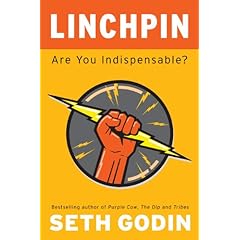 FULL DISCLOSURE: I made a donation to the Acumen Fund to get an advance copy of this book.
FULLER DISCLOSURE: I would have donated twice as much to get it that much sooner because it's that powerful.
This is not a marketing book, though few of Seth's last books really felt that way.
This is a book about becoming indispensable, about becoming a linchpin. However, reading the book is not like reading the map; read the book and become a linchpin-in-training.
In thinking about it, especially because such a large portion of the book is dedicated to gifts, this books is really Godin's gift to anyone that is willing to read, to question themselves, to take the steps to become a linchpin-in-training. As I read through the book, constantly highlighting and dog earring pages, it became clear to me that Godin didn't have to share the information in the book -- he certainly didn't need to share everything in the book. Of course, had he left out any bit of information that he included, then he wouldn't have been practicing what he preached; he wouldn't have given away all of the knowledge that can help you succeed with no expectation of financial gain (sure, he'll make some money from the price of the book and maybe get some speaking engagements, but he could have provided so much less and still had the same outcomes, which makes the book itself a perfect example of the content of the book).
You might be surprised to hear that you'll learn a lot about yourself when reading this book, provided you can beat down the resistance that you may have to doing so. I'll admit that I raced through the book the first time I read it, underlining good quotes and points, but not really applying the knowledge to myself, not engaging the introspection that I should have. So I read it again. Because the resistance was to write a review quickly (which I could have) and not absorb and live the information -- I pushed against the resistance and did it the "hard" way, which ultimately was the more valuable way.
Ultimately this book is about helping you discover the artist that's already inside of you, to create art. As Godin defines it: "Art is a personal gift that changes the recipient. Art is a personal act of courage, something one human does that creates change in the other." This books makes you think about all the ways you can become great at creating art; linchpins, ultimately are artists.
If you're looking for the map on how to do all this stuff, how to be an artist, then, as Godin says: "Here's the truth that you have to wrestle with: the reason that art (writing, engaging, leading, all of it) is valuable is precisely why I can't tell you how to do it. If there were a map, there'd be no art, because art is the act of navigating without a map."
Linchpin will be available on January 26 and presumably will be available in a Kindle version (it will likely show up on Amazon's Kindle site the day of the release).
PS -- my ship date for this review was the end of the day today (January 18): review shipped on time (even though it's not necessarily perfect, I'm done thrashing it).
PPS -- if during reading (or even before reading) you want to give up (or not start), look on page 101 of the hardcopy version; don't be at the confluence.
Friday, January 01, 2010
Apple/Steve Jobs is the . . . of the decade

Steve Jobs: CEO of the Decade
Apple: Brand of the Decade
Apple Inc. Dominates Decade
Can't say that I disagree, but I'm a self-admitted fan of most of the products.
Saturday, December 05, 2009
Apple buys Lala
 It's been confirmed that Apple has purchased Lala and rumors are flying about why they did that. Lala stores music in the cloud and streams it to a user's computer (kind of reminds me, in a way, of what MP3.com was up to before they got sued); as part of the deal, Apple gets the not only the Lala engineers, but also the founder of the company.
This acquisition is not uncommon for Apple -- they buy a lot of small companies and really never disclose the purpose of the acquisition, though it usually becomes obvious 6-18 months later when the integrated technology gets released as a feature, component, etc. Why is Lala getting so much attention?
I don't mind storing my music locally. Broadband speeds to my house are at the point where it just doesn't take all that long for me to download a track or album from iTunes; storage is cheap and gets continually cheaper, so there's not much overhead in storing it. All of my music gets (and everything else on my computer, for that matter) gets backed up for around $4 per month. My music does not necessarily need to be available to me everywhere -- I've got all the music that I want to listen to on my iPhone (it's still got half of its storage empty) and even more music on my laptop (still 60gb free at last count); I'm not sure that I necessarily need to be able to stream music to my laptop and there are places I want music where there is not an internet connection.
But maybe I'm wrong.
The model of needing to own music is probably fundamentally flawed. Subscribing to music is likely going to need to be the model of the future. All of the platforms that I mentioned above -- my home computer, my laptop, my iPhone -- are all platforms that could receive a stream of music, especially as broadband gets more pervasive, and its probably worthwhile to note that all of my platforms carry that little Apple logo and all my current consumption is through iTunes. I've currently got over 30,000 individual songs in my collection, which is a lot, but will never hold a candle to the over 8 million songs currently available on Lala.
And what about the obscure music that Lala doesn't have? Well, they have their "Music Mover" utility for that. I'm not going to claim that I fully understand the technology behind it, but I'm going to guess that just as MP3.com's (pre-lawsuit) utility used to scan the zero track of a CD for identification information and would match against tracks already in their database to give you a 30 second virtual "upload", the Music Mover probably scans ID3 tags, compares them to music in the database, and gives you access to what is already on the Lala servers, actually uploading only what is not already there. Music Mover solves the problem of what to do my entire music collection that I've already got, which is probably my biggest hesitation of moving to an on-demand, streaming model.
Let's go back for a second to my statement about pervasive broadband because that infrastructure is what will ultimately be the reason that streaming succeeds (or fails). AT&T is the current data provider for iPhones in the United States and we've all seen the "map for that" Verizon ads that contrast high-speed data coverage between their networks. If you're like me, one of my big frustrations with satellite radio is when it doesn't work, which, even on Verizon's network, is still a possibility. With physical audio tracks existing on my laptop, iPhone, etc. it does not matter if the data network is reliable; my limiting factor is simply battery life. The big question/challenge for streaming right now is whether or not the technology is adaptable enough to deal with network outages without me knowing about it.
But then again, maybe Apple is simply after something more simplistic.
Maybe the Lala purchase is just to add additional value to an iTunes store purchase -- buy the track for $0.99 and you can download it, buy it for $1.19 without DRM, or buy it for $1.50 and you can download it and stream it as much as you want on the web.
That sounds pretty boring though.
Tuesday, December 01, 2009
Book review: It's Not Who You Know -- It's Who Knows You
 FULL DISCLOSURE: I'm honored to say that I know the author, David Avrin, and that it is my pleasure to review his book. I purchased my review copy (i.e., no galley or comp copy for review) and I think that anyone that knows me, David included, knows that I'm always tougher on people that I know.
This book is about promotion. About tactics and techniques to leverage your brand, your company's brand, yourself to the top of people's minds. David Avrin, the author, says it best: "This book is an unapologetic homage to the power of using creative promotion to attract customers, build your business, and support your families." Ok, he said it better than me.
If you do not have a PR strategy for yourself or your business, this is likely the book for you. However, I will warn you that it is not a comprehensive, step-by-step, spoon-fed, detailed PR strategy guide; I'm sure there are other books for that. What you get with Avrin's book is an easily read, easily consumed strategic basis for a workable PR and marketing strategy.
Avrin covers topics that I found interesting such as representing yourself during air travel (I'm totally guilty of having gone the extremely casual comfort, stick my earphones in my ears immediately route), doing memorable things during conferences and tradeshows, and some interesting tactics for positioning yourself as an expert to the media (did you know that proactive could be a wrong strategy when dealing with the media?). Additionally, for those of you that are unfamiliar with effective web and social networking strategies for promoting yourself or your business and for tracking your web presence, you will find the information in Avrin's book extraordinarily useful.
The idea point breaks in Avrin's book are not big -- I like that. Many business authors feel as though they absolutely have to cram in as much supporting material as possible in between idea points, creating extremely long chapters and, while that is sometimes effective, depending on the subject matter, by keeping the breaks short and the ideas succinct, Avrin's book is easy to read, easy to skip around in, and very easy to use for future reference.
Be visible. That's a big, overriding point in the book and, indeed, why Avrin likely brands himself as "The Visibility Coach". Examples of this range from ideas as simple to producing a large banner to advertise the re-opening of a restaurant to ensuring that you're the one person that actually stands up and asks a question at the end of a presentation/speech when everyone else is sitting, staring at their feet. As Avrin says: "The greatest enemy of success in business is anonymity. Speak up . . . In a flat sea of competitors, it takes very little to stand out and be noticed. Stand out. Be noticed."
There are numerous real-world examples that Avrin ties in throughout the book, but not so many as to be overwhelming -- a few examples to drive the point home and then he moves on to the next point. For those of you that are fans of skipping to the ends of chapters or idea points in the hopes that there is a summary sentence or two, you will be happy to know that each idea point ends with a "The Visibility Coach says:" followed by a short idea point summary.
Thankfully all books are not equally (read the book for more on "All things being equal") and so I highly recommend this book to anyone interested in promoting themselves and their business.
Kindle version available.
Link -- Amazon
Link -- Kindle version
Link -- Visibility Coach main page
PS -- I went to buy some copies of this for some folks today at Barnes and Noble and have come to find that it is mostly sold out in Denver; it is the #1 business book this week in Denver.
PPS -- I'm a proud member of the Homecoming Project and have been for years without actually having a name for it; read the book and join the Project.
Monday, November 30, 2009
Texting while driving = ticket in CO starting tomorrow
 The law that started in California finally arrives in Colorado starting tomorrow: it is a primary offense to be caught texting while driving, punishable by a $50 fine.
A few items of note:
- You can also get a ticket for texting while sitting at a light.
- "Texting" includes e-mail, Facebook, etc. -- anything that requires you to type on the keyboard.
- "Primary offense" means that you can be pulled over for suspicion of texting; you do not have to have committed another violation.
- This law does not include using a handsfree device to make voice calls (unlike California, but I'm sure that's coming too).
- Unfortunately there does not appear to be a good voice-to-text application for the iPhone -- most require a carrier assignment and use the e-mail gateway; ShoutOUT looks promising, but does not yet appear to actually be available.
I watched a cop get interviewed about this on the news this morning and he admitted that it would be difficult in a compressed time period to tell if you were dialing a number vs. texting, but that if there were a reasonable time period in which he was following you, he would probably be able to tell.
Guess I'll actually have to start using the traditional phone function of my iPhone.
Guess I'll actually have to start using the traditional phone function of my iPhone.
Thursday, November 26, 2009
Smartbook AG gets upset with people using the term "smartbook"
Apparently Smartbook AG has a multinational trademark on the word "smartbook" -- good for them. Although they are well justified in defending manufacturers against using the term for competing products, they have also apparently decided to go after media outlets and even some bloggers that are generically using the word to describe next generation devices under the moniker of "smartbooks".
Interesting marketing strategy.
Here's a link to the source about the smartbook controversy on TechCrunch.
Smartbook.
(yup, I'm happy to help)
Interesting marketing strategy.
Here's a link to the source about the smartbook controversy on TechCrunch.
Smartbook.
(yup, I'm happy to help)
Sunday, November 15, 2009
Refreshing interview with Tom DeLong from Blink182
A series of refreshing interviews with Tom DeLong from Blink182 -- I especially like the video embedded below. To whet your appetite, here's a quote from the interview: "I believe that if you look at your band with a modern filter, you can create really cool merchandise, live experiences, an amazing website and monetize all these elements and not worry about selling the record itself. In fact, I believe you should take down every barrier and put as much music out there for free."
(if the embedded video is not working, click here)
4-part video series here.
Transcription of the interview here.
(if the embedded video is not working, click here)
4-part video series here.
Transcription of the interview here.
Sunday, November 08, 2009
Wave invites follow-up
Ok, I got some hate mail from people that posted comments on my blog about the Google Wave invites, so here's my general response:
- I asked you to send me an e-mail in the original post. Not only does it make it easier for me to invite you, but it protects you from having to post your e-mail address in the comments, subjecting you to what would likely be an overwhelming amount of spam.
- For those of you that did elect to post a comment and left your e-mail address, I've rejected all comments so that your e-mail address will not appear where anyone or any spambot can find it.
- This really was designed as a thank-you to people that read my blog; if you had actually read the text of my post, you would have been able to follow the instructions and likely would have received an invitation from me.
Thanks again to my loyal readers.
Ross
Ross
Google Wave invites
I've got 5 Google Wave invites for my loyal blog readers -- just shoot me an e-mail if you want one and, as always, first come, first served.
UPDATE: I'm out for now 3:30PM MST on November 8, 2009. Here's the deal: if you send me an e-mail before I posted this update, I'll save your e-mail address and send you an e-mail when I receive another round. For those of you that posted comments or contacted me in a way other than an e-mail, I'm sorry that I wasn't able to help you.
Thanks for reading.
UPDATE: I'm out for now 3:30PM MST on November 8, 2009. Here's the deal: if you send me an e-mail before I posted this update, I'll save your e-mail address and send you an e-mail when I receive another round. For those of you that posted comments or contacted me in a way other than an e-mail, I'm sorry that I wasn't able to help you.
Thanks for reading.
Wednesday, October 28, 2009
3 Google Voice Invites
If you need one, drop me an e-mail -- first come, first served until they're gone.
Monday, October 26, 2009
Some thoughts about Tesla Motors
 For those of you that follow me on Facebook, you know that I was luckily enough to be invited to a very VIP event prior to the opening of the Tesla Motors gallery in Boulder this past Friday evening.
Here are some things that I learned and observed:
- Elon Musk (co-founder of Pay Pal and CEO and major investor in Tesla) is a committed guy and very well-spoken. He fielded questions from a small, but influential group of people with aplomb, converting technical questions into easily understandable answers that not only provided digestible technical information, but showed his passion for the brand. Furthermore, he was very approachable at the individual level and I enjoyed the few minutes that he spent speaking with me.
- Tesla currently only produces their roadster and the sedan is still a couple of years off. All of the profits from the sale of the roadster are plowed back into the development of the sedan -- they are using a limited production, expensive showpiece to fund mass market vehicles, so everyone that purchases a roadster becomes an investor.
- Colorado currently offers a $40K+ tax rebate that, combined with Federal tax incentives, brings at total of $50K+ in rebates, provided that you receive delivery of the vehicle by December 31, 2009 in Colorado -- this is a pretty powerful motivator as it cuts the price of the roadster by about 50%.
- Tesla did receive $400mil+ as part of the whole bailout program, but Elon claims that they have not experienced any problems with government involvement from the investment; the "problems" that they have with government entities are the strict regulations and "hoops" they have to jump through to be able to sell the cars as drivable in the Unites States.
- Repairs for Tesla automobiles are currently performed by "Repair Rangers" -- basically the repair guys make house calls at the price of $1 per mile for travel plus the cost of repairs.
- Tesla is not only manufacturing their own vehicles, but also providing electric drive trains to others, notably the forthcoming ElectricSmart.
- The timelines for production are considered "impossible" by normal automakers -- their cycle for the sedan is 3 years from concept design to production.
- Individual consumers cannot purchase "beta" models of new production automobiles, but those that put down deposits on the forthcoming sedan will be invited to take rides in pre-production models.
- In talking with representatives of EV cell manufacturers and other alternative energy source manufacturers, you truly could, given enough money at this point, install a solution in your home that would power your Tesla with no fossil fuel required.
- The environmental manufacturing cost of vehicles, according to Elon, with some exceptions, is roughly equal to the retail cost, so the environmental manufacturing cost of a Tesla at around $100K is about the same as a $100K Lotus.
- Tesla aims for 5-star crash ratings for all of its vehicles, and those ratings get harder to achieve each year.
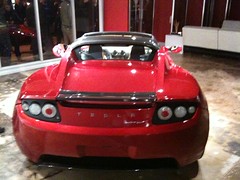 The cars themselves are gorgeous and are made for Tesla by Lotus, so they are similar in size to the Lotus Elise, though the cockpit seems a little bigger and there are definite exterior and interior design differences. Fully loaded, the Tesla Roadster Sport will run you about $150K and it looks fast just sitting still. Due to the nature of the engine and drive train, the Roadster Sport does 0-60 in 3.7 seconds (they actually were postulating that it did closer to 3.5-3.6 seconds in the higher altitude due to the thinner air and drag; the altitude has no effect whatsoever on the engine performance) because every bit of torque is available from the second you hit the gas.
Link -- Tesla Motors
PS -- the food and space at The Kitchen in Boulder was spectacular and I was glad to meet Kimbal, the Chef-Owner and Elon's brother; I look forward to returning for a great meal.
PPS -- If you want to schedule a test drive in Boulder, call Tony Longhurst at (303) 440-3758 and he'll take care of you.
PPPS -- If you have been looking at buying one of these and want to chat about me purchasing one on your behalf prior to December 31, drop me an e-mail as I am a Colorado resident eligible for the tax incentives.
Saturday, October 10, 2009
The problem with AIROPTIX Night & Day Aqua contacts and what to do about it
 I've worn Focus Night and Day contacts without significant problems for a number of years; basically since they came out. This past August I went in for my Colorado state-mandated annual prescription review for contacts and was informed that Ciba Vision, owner of the Focus brand, had "improved" the Focus Night & Day line by taking the same lens, coating it with some sort of fancy, buffered coating and by adding a tint and lettering on the lens that said "ok" if the lens was in the correct position (i.e., not flipped the wrong way). I popped in the new sample lenses at the optometrist's office, they seemed fine, and so I ordered a year's worth of lenses. That's when the problems started.
Never before had I really needed to remove my lenses to clean them, but it seemed like I had to do it daily; never before had I had a problem sleeping in my lenses, but I was waking up needing to clean them. Although it seemed like some of the itching and burning in my eyes may have been allergy-related, I've never really had allergies, and when I removed my contacts, the symptoms seemed to almost immediately disappear; it got to the point where I was either carrying a contact lens case with solution or throwing lenses away when I was at work because I couldn't take the irritation.
Finally a couple of weeks ago I decided to take a break from the lenses and even went to see if I was a candidate for laser surgery as I had promised myself that if I could no longer wear extended wear lenses, I would get the surgery. While I was at the laser eye surgery consultation answering questions, the assistant asked if I had any problems with the AIROPTIX because there apparently were massive problems with the lenses and that Ciba Vision was aware of the problem and exchanging lenses. I immediately called my optometrist and he confirmed that there were issues, Ciba was aware of the issues, and that Ciba would exchange out the AIROPTIX for stock of the old Focus Night & Day with no questions asked. Furthermore, he offered me a couple of free pairs of Bausch & Lomb PureVision lenses along with a prescription for those -- PureVision is the Buash & Lomb extended wear lens.
If you're having the same issues I was, here's what I suggest:
- Stop wearing the lenses immediately. If you think you have an infection or some other negative effect from the lenses, call your optometrist immediately.
- Call your optometrist that wrote the prescription -- chances are that they are aware of the issue and can get your lenses switched out by their Ciba rep. Chances are also good that they may have some samples of the older Focus Night & Day lenses that they can give you until Ciba gets you new lenses.
- Ask your optometrist to give you some samples of PureVision. I'm sure that Bausch & Lomb is loving that Ciba has screwed this up and is loading up optometrists with extra samples to convert customers.
- Should your optometrist be unwilling or unable to help you, call Ciba directly as they are aware of the issue -- (800) 875-3001.
Friday, October 02, 2009
Bay Cities Deli
 Those of you that have not lived in LA, and perhaps those of you that don't or didn't spend much time on the Westside and around Santa Monica, have probably never heard of Bay Cities Deli. The Deli is right on the corner of Lincoln and Colorado, just North of where the 10 hits Lincoln. Most of the time the parking lot is packed and on weekends they actually have someone in the parking lot to direct traffic into parking spaces.
Inside, Bay Cities is packed and cramped and full of fabulous food items from their cheese selection to their bakery to their wine selection to, of course, their deli. As you would expect, considering the word "deli" is in their name, Bay Cities has an incredible deli. You will not find better meat products, prepared foods, and salads; every meat to be sliced in the case if it is not some sort of custom product, is a Boars Head product. Of course, with all of the fabulous bread, cheeses, and meats, Bay Cities puts together some amazing sandwiches.
 When I lived in Venice, there were many Sundays when the line at the deli inside Bay Cities was 30-45 minutes long and all of us in line were willing to wait for sandwiches -- the best sandwich, in my opinion, however is the Godmother. Served on their fresh french bread, the base sandwich consists of Genoa salami, mortadella, coppacola, ham, prosciutto, and provolone -- no substitutions are allowed and if they description of ingredients got your mouth watering, you'll know why. Following the base sandwich, you can add the normal fixings, but most get it with "the works", which consists of mayonnaise, your choice of mustard, onions, pickles, tomatoes, lettuce, Italian dressing, and you choice of mild or hot pepper salad. A word of warning: if you get the sandwich with the works, eat it within 15 minutes or so of it being assembled or all of the amazing oils will begin to make the bread mushy; not that it tastes bad, but it may cease to function in the classical sandwich manner (i.e., you might need a fork and knife).
Due to the popularity and potential length of line, it was always challenging for me to grab a sandwich on my way out of town. However, Bay Cities now has online ordering, which is amazing. Allow me to note that this is not automation for automation's sake -- the automation in this process truly solves a problem for customers like me that know exactly what they want: I can get in and out without waiting in line. To support the online ordering, they carved out a corner of the store well away from the normal deli line that only fulfills online orders and catering orders. I will admit that the online ordering system is rudimentary (i.e., not very fancy), but it works and it works easily on my iPhone. Just log on to the site, put in your order, and they'll make it; you need to give them 45-60 minutes (they won't even talk to you about your order not being up if it hasn't been 60 minutes since you ordered). Once you arrive, you stand with the rest of the people that have ordered online and sift through the orders on the gorilla rack -- they just print out the order sheet and wrap it around the sandwich, so look carefully for your e-mail address.
I was just in LA last Sunday, placed an order on my iPhone during brunch, ran into the store while my friend waited in the alley (far enough away for the parking guy to not yell at him), ran up to the rack, found my sandwich, and was out in less than 5 minutes. The sandwich that I brought on the plane only had mustard, lettuce, and pickles on it because, to be honest, everyone on the plane starts drooling with the smells coming off just the base sandwich; if you load it up with the works, you will assuredly send the smell of all that stuff throughout the entire plane air system in addition to the complications you may face with the sandwich getting mushy from all the oil.
If you live in LA, it's definitely worth a trip; if you're traveling through and flying out of LAX, bear in mind you can swing by, hop on Lincoln, and take Lincoln straight to the airport.
Link -- Bay Cities main
Link -- Bay Cities online ordering
Thanks to The Delicious Life for the pic
Sunday, September 06, 2009
Get the USBConnect Mercury to work with Snow Leopard
This isn't too hard, but annoying that no one really has a good set of instructions, so here you go:
Enjoy.
- Leave the modem out of your machine's USB port
- Download this software from SierraWireless if you've previously installed SierraWireless software
- Run the "Watcher Remover"
- Restart your machine
- Open "System Preferences"
- Click the icon that's likely blank with a phone icon
- From the drop-down that likely says "Default", select "Add Configuration"
- Label it something like "ATT"
- Click "Advanced"
- Select "SierraWireless" from the "Vendor" list
- Select "GSM" from the "Model" list
- Click "Ok"
- Make sure you check the box that says "Show Modem Status in Menu Bar"
- Close your Preferences (you should now have the little phone icon on the upper right of your screen where the time is typically displayed)
- Insert the USB modem
- From the phone/modem icon in the upper right, select "Connect" (if the connection profile you just created is the only one you have, it will automatically have a check mark next to it; with multiple connections, make sure the connection profile is checked)
Enjoy.
Monday, August 24, 2009
Is the leather armrest on your Yukon/Tahoe cracked? I've got the solution
 I like my Yukon and I've always enjoyed my Chevy and GMC vehicles, but they do not use the best quality leather when wrapping the seats, meaning that around 40,000 or 50,000 miles, depending on use, the leather on the driver's armrest will probably start to crack. Not only is this leather cracking aesthetically unpleasing, but it also is uncomfortable on your arm; and if you store the armrest back in the seat, the geometry of the cockpit doesn't feel right.
My first sop in my quest to fix this problem was Pep Boys: although they admitted that this is a very common request (look at suburban streets in Colorado and every other driveway seems to have a Yukon or Tahoe in it), the only solution that they had was to stretch a lambskin steering wheel cover over it -- no. Then I ordered a neoprene cover, but because it was designed to fit over the leather without the armrest being removed, the velcro straps kept coming loose and it kept falling off (plus it looked really goofy). Finally I found The Seat Shop on the internet.
Here are a few tips about removal and installation:
- Have the video handy somehow -- a nice laptop screen in the vehicle with you is helpful.
- The leather of your seat cover has a lot of give, so don't be afraid to really stretch it to get at the ball and joint mechanism.
- Before you start removing parts and pieces, you should jam a plastic shopping bag or some white paper into the opening behind the joint that leads into the seat -- anything you drop will sind up contained within the area around the joint and not fall into the seat.
- You have to remove a rubber o-ring (they call it a "rubber band") -- don't lose it. I recommend using some 90 degree needle-nose pliers and/or tying a string to it before you remove it. Luckily if you do lose it (I didn't), it's about the size of a standard scuba tank o-ring, which you should be able to locate (probably free of charge) from a nearby scuba dive shop.
- After to remove the rubber o-ring, you have to remove a u-shaped clamp. I recommend loosening the clamp as shown and then bending a paperclip around the convex "u" portion as the clamp is under pressure and jumps when you remove it.
- Pull the armrest off.
- Put the clamp and o-ring back on the joint as soon the armrest is off and tuck the leather from the seat cover back in.
- Follow the instructions in the video to apply the leather sleeve (note that you really have to stretch the leather and get the sleeve zipped on before going any further). Once the sleeve is on, cut (yes, cut) the leather as shown in the video.
- Put the armrest back into place and push in on it hard until you hear the clamp click -- when you move the armrest up and down, it should not move laterally once the clamp is in place.
I messed up this process and lost the u-shaped clamp, which is not a part that GMC stocks. There are a few options, though I employed the last one:
- Lean your seat all the way forward, unclip the leather cover from the bottom, and fish around until you find the clamp. You can watch the cover installation video to try and get the cover back together or can leave it unclipped once you recover the clamp.
- The Seat Shop can fax you instructions on how to modify a medium binder clip to work -- basically you just clip the thing with some wire cutters and create (as best you can) your own u-shaped clamp.
- AutoZone sells a package of u-shaped window handle clips -- the largest clip in the package is almost too small, but it works; you just have to be patient on getting the o-ring around the flanges.
During this process I did have a chance to talk to one of the guys at The Seat Shop. Not only are they very friendly guys, but they really are knowledgeable about what they are doing. He ran through all of the options above and was luckily able to get me headed in the right direction to get my armrest working. Additionally, I had initially ordered the wrong color, so he sent me a new cover in the correct color free of charge. He did tell me that a lot of his business is direct to consumers that then take their products to an installer; he told me that he makes covers by purchasing 20,000 yards of leather and sewing off of that as opposed to local shops that buy in much smaller yardages and charge a lot more.
I'll tell you that the quality of the leather on The Seat Shop covers is visibly and texturally superior to what GMC uses. If ever my seats start to crack, I will be ordering replacement covers from these guys and having them installed. Note that, although my vehicle already has a third row of seats, The Seat Shop also sells the brackets, parts, and covers to install an aftermarket third row in your vehicle.
I'll tell you that the quality of the leather on The Seat Shop covers is visibly and texturally superior to what GMC uses. If ever my seats start to crack, I will be ordering replacement covers from these guys and having them installed. Note that, although my vehicle already has a third row of seats, The Seat Shop also sells the brackets, parts, and covers to install an aftermarket third row in your vehicle.
Link
Wednesday, August 19, 2009
Book review: Never Eat Alone
 Never Eat Alone is not a new book, in fact, it was written before Keith Ferrazzi's new book, Who's Got Your Back, that I reviewed a a few weeks ago. There are a number of references to NEA in WGYB and I had been meaning to read it for a long time, but noting that there were somewhat tactical references to it in the more recent book, I bumped it to the top of my reading list.
Unlike many other business authors that can seem to abandon ideas in their previous books, I actually think that you can get more value in reading NEA after reading WGYB. Although my review of WGYB states that there is a good amount of tactical tips that are actionable, NEA is, in my opinion, a tactical companion to WGYB -- WGYB adjusts your mindset in a certain way and NEA gives a lot more actionable steps about how to reach the goals of your WGYB mindset.
Among the strategies in NEA are specific actionable toolkits such as getting past assistants that view their job as protecting their boss from speaking to you and making cold calls. There are lists of steps to ensure that networking interactions are worthwhile and that your expectations are correctly set, for example with cold calls:
- Conveying credibility
- Stating your value proposition
- Imparting convenience and urgency
- Being prepared in advance to offer compromise
As with WGYB, there are a lot of reviews that bash on Ferrazzi for name-dropping and for fake modesty. In my opinion (still) the name-dropping adds legitimacy to a lot of the real-world examples of putting the tactics to work and I think that Ferrazzi has a good personal story that shows how he made his way out of growing up in a blue collar town.
Worthwhile read.
Kindle version available.
Link -- book
Link -- Kindle version
Worthwhile read.
Kindle version available.
Link -- book
Link -- Kindle version
Subscribe to:
Posts (Atom)