Thursday, April 09, 2009

Book Review: Personal Development for Smart People

FULL DISCLOSURE: I received a complimentary copy of this book for review.

I have to start off by apologizing to the author: I requested a copy of this book for review because I really like his blog and it migrated to the bottom of my review pile -- guess I forgot about the basic inventory rule of FIFO (First In First Out). All of that having been said, Steve Pavlina, the author, writes a great blog about personal development that I read daily (or as often as he posts) and has produced a great book.

Steve's got a great personal story that you can read about in the introduction of his book, but it boils down to him having a turning point in life when, after having been arrested for theft, he received community service instead of a stronger sentence. After acknowledging the turning point, Steve dedicated himself to starting a business and reading every personal development document that he could get his hands on, extracting knowledge that worked and discarding stuff that did not -- this book is a distillation of hundreds of books and documents on personal development.

The book itself is broken into 2 parts: (1) Fundamental Principles, and; (2) Practical Application. As expected based on the labels, the first part of the book introduces the underlying structure for personal development, and the second part of the book shows the application of the principles.

Being a long-time reader of his blog, I found the same writing style in the book to be very familiar: Steve writes in a very direct way and, although I've never spoken with him, my guess is that Steve is one of the few writers that writes exactly as he speaks. None of Steve's writing is esoteric and he favors succinct language to get his points across instead of flowery prose.

For those of you that have read personal development books in the past (I've certainly read a few), you will find this book dramatically different (I would call it "refreshingly different", though I'm sure there are those that would disagree). Bear in mind that this book is, as stated previously, a distillation of hundreds of works about personal development, so it is, by virtue of its approach, very different.

I'm not going to lie: there is some spiritual stuff in here that may not be appealing, but on the whole, the principles are useful and the practical application portion is very useful even if you don't necessarily subscribe to all the principles.

Definitely a worthwhile read.

Kindle version is available.

Link

Book Review: Ping

FULL DISCLOSURE: I received a complimentary copies of these books for review.

Did I just say "copies"? Yes, I did; well, sort of. I actually received a paperback that bound together 2 books:
  1. Ping: A Frog in Search of a New Pond
  2. The Way of Ping: Journey to the Great Ocean
Both of these books are parables about a frog named, unsurprisingly, Ping. In the first book, Ping decides to leave his home pond for a better life and encounter roadblocks that he must deal with along the way to reaching his goal. In order to deal with the roadblocks, Ping finds that his optimistic outlook and existing skill set are not enough and that he not only needs new skills, but needs to adjust his though process. Ping is back in the second book on another journey, but delves deeper into the change process by sharing his experiences and knowledge about his process with others.

Although I have read some better change management books, I do like the way the ideas are presented in the parable format; it has been my experience that you can get more engagement across an organization through parable-based business books that seem less intimidating. I will say that there are a large number of platitudes that are a little less than useful, but the books are a good and easily understood start on principles of risk-taking and change.

Unfortunately the copy that I reviewed with both books bound together does not seem to be available (it is stamped with "Two-in-one Advance Reading Copy", so that makes sense) on Amazon.

Neither book is available on the Kindle.

Link -- Ping

Link -- The Way of Ping

Why I put the availability of a Kindle version in my book reviews

You might not be like me. You might not have made the decision to purchase only books in electronic form from the day that you purchased your first Kindle. That's ok.

But here's my deal: I will continue to review books that are sent to my in hardback or paperback, but I feel that as a reviewer I should let you know whether or not you can consume the book electronically.

I'd want to know and I figure some of you might want to know.

PS for publishers, marketers, etc.: you will get a much faster review if you send me a Kindle-capable version of your book.

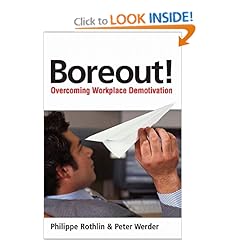
Book Review: Boreout! Overcoming Workplace Demotivation

FULL DISCLOSURE: I received a complimentary copy of this book for review.

I'll be honest: I've been slow in reviewing this book because it seemed, well, boring. All of us have had jobs throughout our career where we've been bored; I remember working in retail one summer in college and it was mind-numbing. However, most of us that have been successful figured out how to turn boring jobs into opportunities. The short story is that I didn't really think that there was much to learn from this book.

Here's what I failed to consider and what makes this book important: I've been in a position where I have had so much on my plate for so long that I can no longer relate to what the authors term as "boreout". More importantly, it's important, as a leader, to look for the signs of employee boreout and how to combat it.

One of the things the authors point out is that many employees that are bored will actually ask for more work, but there is a limit on the employees being proactive about this; sooner or later they give up. Although the authors cover potential economic impacts and out-of-work impacts, the reality is that most people don't go into a job looking to be bored -- employees are looking for meaning in their work (and they need something to work on to find that meaning).

The book is structured to be a quick read with important message call-outs throughout the chapters in gray shading. If you are looking for the skimmer's version, you could flip through the pages, read the items in gray, and get a good sense of the main ideas.

Worthwhile read if your an employee facing boreout symptoms or if you are in a leadership position in a company.

No Kindle version available.

Link

Tuesday, April 07, 2009

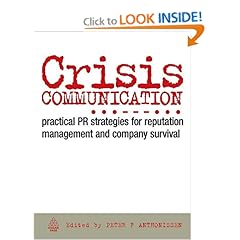
Book Review: Crisis Communications

FULL DISCLOSURE: I was provided with a complimentary copy of this book for review.

Although those of us in business don't necessarily like to think about it, having a PR strategy for crisis situations is becoming more and more necessary. Instead of a single author, this book pulls together 20 authors, all senior crisis communication consultants from IPREX, which is a worldwide network of international public relations agency (I had never heard of it before reading this book). By leveraging the presumably best consultants in each of the individual crisis areas, the book is a great reference tool for anyone in business.

I initially figured that the book would focus on large crisis situations, but there is useful advice on how to handle topics such as reorganization and restructuring, fraud, and negative press. Although I was expecting it to be more traditionally focused, the book spends a good amount of time exploring strategies around using the web as a PR vehicle and the new rules, risks, and rewards around it. Most of the chapters include real life examples and/or case studies that really bring home the points for each topic and I'm a big fan of that style of writing in business books. Furthermore, there are a large amount of templates that range from strategic planning tools, actionable checklists, and sample press release copy (the press release copy samples are extremely useful as opposed to Googling for samples that you hope are well-written).

Certainly worth having a copy on your shelf even if you don't read it cover-to-cover even if you, like me, hope you'll never need it.

Too bad it's not available yet in a Kindle edition.

Link

Book Review: The Tax Lady's Guide to Beating the IRS

FULL DISCLOSURE: I was provided a complimentary copy of this book for review.

I didn't actually think that I was going to like this book as I have a very good CPA that I trust, but then I decided to read it from the perspective of someone that files their own taxes. Once I got into that frame of mind, I found this book to be extremely well-written with lots of tips that ordinary people could leverage for personal tax savings. I especially liked the detail in which the author, Robin Lynn Deutch, went into with regard to using investment vehicles such as IRAs and 401(k)s to realize large tax savings -- these are the double whammies of not only saving on taxes, but investing in your future.

The book flows well and has action steps , "Fast Facts", and "Tax Tips" clearly called out throughout the chapters, which can allow you to get through the material very quickly. There are good explanations of IRS procedures and good tips about what do and what not to do when filing your returns.

At the end of reading it, I found that it reinforced the fact that I have a great CPA as there wasn't anything in the book that we hadn't discussed; you may wish to pick up a copy just to judge the value of your CPA. Furthermore, if you file your own taxes and are looking to evaluate your options and overall tax strategy, I have not read a more easy-to-digest book on the subject.

Note that this book appears to be updated yearly as there tend to be minor and potentially major changes to tax codes that affect individuals on a yearly basis.

Link

Saturday, April 04, 2009

Lessons for tough times

From the Businessworld interview with Shumeet Banerjl, CEO of Booz and Company come some excellent lessons.

With regard to being better equipped for recessionary times:
There are two most important lessons that a company should learn. One is that debt is a good thing, but you have got to watch capital structure where you have debt deployed for acquisitions. The second lesson . . is that chasing valuation is a bad basis to build companies. If you build fundamentally strong companies, you get good valuations, but it doesn’t work the other way round. Good companies pay attention to ensure that they achieve an adequate balance between top line investment and operating costs.

What companies can do instead of just cutting costs:
. . . there are tremendous opportunities that will emerge in this situation. And in order to make that happen we take two or three ingredients. One is industry structure and dynamics. What do you think will be the shape of the industry in two years from now? You don’t have to be right, you have to be more or less accurate. Second, what role are we as a company going to play in that structure? What is the shape of assets we would like to own? What kind of capabilities do we need, and where will we get them from? And third, that cash is king has never been truer. Do we have the balance sheet strength and the capital sources to ensure that we can move fast when opportunities emerge? We have seen again in the course of the past few months that opportunities have risen dramatically and very, very fast. And being in a position to act on those is very important.
Good interview.

Link

Gmail web interface and Twitter user?


You should check out TwitterGadget -- it embeds a fully functional Twitter client within the Gmail web interface.

TwitterGadget can also be used in iGoogle or by itself, but follow these instructions (5 steps) to embed it in Gmail.

Link

SkipScreen

The functionality of SkipScreen is cool (it lets you skip past all the silly screens that RapidHost and others throw up before letting you download), but their logo is cooler -- look at the words below the large letters:


Link

Tuesday, March 31, 2009

I've done a 180 and I'm back to the iPhone

For those of you that are smacking your foreheads in disgust after reading why I switched to the Bold, please give me a second to explain:

I was recently on an unplanned-for trip that was booked at the last minute and various things throughout the course of the trip made me realize that the Bold is not a suitable substitute for the functionality of the iPhone; I do still have some of the same gripes with the iPhone (battery, keyboard, reception, etc.), but I was unaware of how much it affected my day until I didn't have it.

Here's what brought me back:
  • Applications. I use them. A lot more than I thought. BlackBerry doesn't have them and the mobile versions of the sites for which I have iPhone applications don't measure up. Even something as simple as the weather application on the iPhone blows away the same push-based functionality on the Bold. Hey, I'm also pretty excited about the Kindle application too as that makes my whole investment in that series of products and distribution model more useful.
  • Browser. I never had a good idea of how much I used the browser until I had one that didn't work as well or as easily. iPhone = real web browsing; Bold with Opera doesn't.
  • Gmail. The Gmail app for the BlackBerry sucks in comparison to the e-mail experience via Safari on the iPhone -- not RIM's fault, but I use it an awful lot and the experience is much better on the Bold. And, for those of you that may point out that I could have my Gmail come to my Inbox on the Bold, I separate my work and personal e-mail by using separate applications.
  • Google Tasks. Works on the iPhone and not on the Bold, and I'm addicted to using it, it's part of my daily work-flow, etc.
  • Camera and pictures. Never really noticed how much I use the camera on the iPhone and picture manipulation until I couldn't do it in the same way -- interacting with pictures on the iPhone leaves the Bold in the dust.
  • Cords. One cable to charge my music device and phone. I don't know about you, but reducing cables and chargers and other device-specific crap is important to me when traveling.
To address some of the outstanding problems, I've made the following moves:
  • Reception. Can't do much about it, so I'm going to live with it and hope that Apple releases software updates to address it and that AT&T continues to improve their backbone. Note that I saw very similar signal coverage in San Antonio (home of AT&T), but still experience issues in Denver.
  • Keyboard. I'm getting very fast at inputting via Shapewriter; my biggest problem is wrapping my brain around the process of invoking Shapewriter before I initiate or respond to an e-mail. I know people that hate Shapewriter, but it totally makes sense to my brain and has drastically increased my input speed for lengthier e-mails.
  • Battery. I've invested in the Richard Solo battery, which I can't imagine having attached to my phone when using it for a voice conversation, but everyone that I've talked to has said that it's been an amazing device for them while traveling.
I'm done switching for now unless one of the new Nokias really catches my eye and/or the new iPhone this summer is super-cool (I'm sure it will be). And, yes, I'm eagerly awaiting a lot of the functionality from the iPhone 3.0 software suite.

The definition of "rocket science"

This video is way too funny:

How many rocket scientists do you deal with on a daily basis? I think I'm going to get the quote framed on my wall.

Thanks to John Sparks for the tip.

Link (if the embed isn't working for you)

Sunday, March 29, 2009

XM/Sirius

I've said all kinds of things about satellite radio over the years, so I won't rehash them now. Here's what I think:
ClearChannel went back private a few years ago and traditional radio is not necessarily doing very well. Although none of us are able to look at ClearChannel's cash position any longer with them having gone private, I would be willing to be that they have a warchest. I'm guessing that they're looking hard at purchasing the combined XM/Sirius entity, especially at a discount price -- I almost wonder if the bankruptcy was a takeover protection effort.
Just my $0.02, but it seems like radio has a strong history of simple consolidating stations and channels to maintain advertising revenue instead of directly addressing the problem -- XM/Sirius, at its core, is just another set of stations and channels; it's just delivered via a different medium.

Tom Peters shares his strategies for the recession

Read carefully.

Link

Verizon Math

I don't remember the source of this, but I originally came across this audio recording of a guy's frustrating conversation with a Verizon customer service rep regarding the difference between 0.002 dollars and 0.002 cents (there's a hundredfold difference for those of you without calculators as there are 100 cents in 1 dollar). You can listen to the audio recording here, though it may want to make you drop Verizon if you're a current customer. After a little Googling (a very little, by the way), I found the blog dedicated to this silly stuff -- you can read it here at Verizon Math.

Aside from the actual content, which, by the way is appalling (yet funny), think about this: 10 years ago none of this could have happened. It would have been expensive to get the gear to record the call at a high quality level, it would have been very expensive and slow to digitize the audio, it would have been insanely slow to upload the recording, most people would have been unable to even find the recording because of a lack of broadband penetration and inefficiency of the webscape, and even if they had found it, it would have taken forever to download and could not have been easily shared.

Dell has a team of people that now respond to things like this and it's not hard to respond -- search engines and blog-specific searches make the job infinitely easier. The problem for big companies is that if they do not address items like this early, then they wind up with exactly what Verizon Math is: a perpetual bad experience story with high Google rankings that will always show up in search results because people find it and bloggers like me continue to link to it.

Are you watching after your online reputation?

Thursday, March 26, 2009

Now you can get Taser'd from more than 80 feet away


Sure looks non-lethal to me.

Link

NIN|JA


You can download an exclusive EP from Nine Inch Nails and Jane's Addiction in support of their summer tour: just give them your e-mail address and they'll send you a download link. There are lots of formats available, including FLAC and Apple Lossless, and all of the links are torrents, so you'll need a torrent program to process the download.

Link

Friday, March 13, 2009

What if you actually let your customers decide what to pay you?

Matt Homann from LexThink has what he terms a "You Decide Invoice" that he uses for all of this consulting work. Here's the relevant language:
YOU DECIDE: Your absolute satisfaction with LexThink isn’t just our goal, it’s the measure of our worth -- and the determination of our fee. The rules are simple: you pay us what you feel we were worth to you. You decide, no questions asked. The only rule? We want to know why you paid what you did, and how we could have done better.
For those of you that rightly worry about payment, here's how he deals with that:
WHEN TO PAY: While we leave our fee in your hands, we can’t leave it there forever. Please send us your payment and feedback within 21 days after you get this invoice. Please send a copy of this along with your feedback and your payment. Thank you for your business.
Check out Matt's post for an image of his invoice template along with other useful information about his process, including the solicitation of feedback from his clients.

Link

The granson of Ansle Adams is helping us enjoy Ansel Adams print reproductions


Scoble has a video about the grandson of Ansel Adams, Matthew Adams, making nearly indistinguishable copies of Ansel Adams prints from the original prints, not from the negatives. I'm a big fan of Ansel Adams, so this is pretty exciting news to me considering the fact that there are a finite number of original prints and they are very much outside my price range.

Check out the video and listen to how they do it: Link

This guy build a 747 flight simulator in his warehouse for under $200K

The real ones cost $40mil and apparently his is pretty close.

Now this simulator took 10 years to build and a lot of the parts were donated to the builder in exchange for work, but it's still pretty impressive.


Certainly makes you think about what is possible given the time and effort.

Link

After the standard 15-20 month wait, GrandCentral is becoming Google Voice

After a 20+ month wait since the acquisition of GrandCentral by Google, the "phone number for life" service is relaunching as Google Voice. As an early user of GrandCentral, I am very glad to see that Google Voice is adding in many of the features that have been missing from the GrandCentral service, namely:
  • Text message forwarding. The Google Voice number will now forward text messages to your mobile device and it appears that you can respond to the messages via the Google Voice number or direct from your mobile phone.
  • Phone calls via the web or your mobile/landline. Some of these features have been a part of GrandCentral for a while, so it will be interesting to see if there is an additional feature set.
  • Free transcriptions using the GOOG-411 engine. Due to the fact that I currently pay for PhoneTag, I will be very interested in the accuracy of this service. You can read a reaction to this announcement made by James Simnoff of PhoneTage this morning -- in short he says that he looks forward to being able to say that his product is better than Google's; I wonder if Google's will simply be good enough to cause people like me to stop paying for transcription through third parties.
  • Easy conference calling. Simply have the people you want to conference with call your GrandCentral number, and add up to 5 of them to the call using the keypad interface.
  • Free calls to the US and aggressive international rates. I don't have the international rate chart, but assuming that you can easily make web-based calls using the service, this could be useful.
Current GrandCentral users have to wait for the upgrade notice to show up in their Inbox (mine currently tells me that I am ineligible for an upgrade). There are some things that I'm hoping for that have not yet been confirmed:
  • Google Voice shares my Contacts from Gmail to resolve callerID and provide a single contact database.
  • Google Voice messages automatically show up in my Gmail account. Lifehacker reports that the "voicemail" label is now reserved by the system in Gmail, so it seems there's a pretty good chance that this will happen.
  • Ability to initiate web-based calls directly from the Gmail interface.
Google Voice is currently only available to existing Grand Central users and to people upon whom Google bestows invitations -- if I get some invites, I will certainly let you know.

Link