Want to enhance your iPhone without Jailbreaking? Do you wish that you could change phone settings via an icon shortcut instead of having to go through the settings icon and traverse multiple menus?
Just visit the IconSettings site from your iPhone.
(give it a few seconds for the icon to show up on the screen once you create the shortcut)
Wednesday, November 16, 2011
Wednesday, October 12, 2011
If you think those autocorrect sites are funny ...
... then you'll love Shit That Siri Says.
This can only get funnier as the distribution of iPhone 4S phones gets broader.
This can only get funnier as the distribution of iPhone 4S phones gets broader.
SMS started to die today
iOS 5 went live to the general public today, which means iMessage went live to the public today.
Mark my words.
Mark my words.
Tuesday, September 20, 2011
A great book that helps end disease
I've read a bunch of great business books, though very few of them in the past have been compilations from amazing people centered around common categories. I find that I consume more business knowledge these days in reading blog posts, so, regardless of who or how many people are authoring a book, I find myself enjoying books that are organized like blog posts.
 It was my pleasure to read End Malaria, the most strangely named business book that I've read in at least the past 12 months. End Malaria represents a book that is used as a vector to help end malaria-related deaths by 2015 -- $20.00 of each sale goes directly to Malaria No More.
 What's great about the book besides the amazing mission is the fact that all of the great authors have donated their insights and writings for free, and those writings and insights have been organized around common topics in blog post format (please see the first paragraph of this post if you are confused about why I think that's great).
Authors and contributors of note:
- Seth Godin
- Gina Trapani
- Jim Kouzes & Barry Posner
- Tom Peters
- Patrick Lencioni
Buy the Kindle version like I did for $20 and the full amount goes direct to the charity.
How does gun regulation work when you can print parts?

If you click the first link, you can have produced for you (read: printed for you) the lower receiver for an AR-15 rifle, which, technically, is the only part of the rifle that requires you to have a license in the United States. Clicking on the second link will allow you to print an AR-15 magazine that is big enough to hold more than 5 rounds, but doesn't include the spring design, so it's a 5-round magazine; presumably a talented person could put that design into a modeling program, extend the clip length and make it to accommodate some number of rounds that pushes it into regulation territory, but as is, you can buy the same factory version of a 5-round magazine without any sort of license right now.
The fundamental problem or question or point of debate around all this is whether or not this is illegal or immoral or wrong. Thing is that no one really can answer whether printing a regulated weapon component is the same as buying one. Most of the places that could print things like this for you discourage you from uploading weapon designs and producing weapons, but draw short of regulating because the production of such items is not currently illegal.
Personally I am not sure that I'd want to fire a weapon that had a receiver made from a 3D plastic printing place. I know that there are composite and carbon fiber receivers available on the market for the AR-15 that are designed for heavy use, but I'm not sure that's what you're getting out of a 3D plastic printhouse. Doesn't mean that won't change in the future if you can specify the actual output material and performance specifications.
Bear in mind that the lower receiver alone is not enough to make a weapon -- you do still have to locate and assemble the other parts.
Please note that I'm not advocating you doing any of this -- I wouldn't want to be anywhere near a rifle built around this when a bullet wen through it.
Wednesday, July 20, 2011
What's your secret sauce?

Click right here and you can download the parts list and wiring diagrams at absolutely no cost from BackBlaze.
Why would BackBlaze do this? They're in the business of selling cloud-based storage and they do it at extremely affordable prices (think $50 per year for unlimited cloud storage); their hardware is a big part of what allows them to keep their prices so low ... right?
Not really. It turns out, as BackBlaze shows in their hardware plans, that outside of the custom enclosure, everything else inside one of their storage pods is commodity hardware. Anyone with enough time could probably build one of their storage pods, so they have no problem giving away the hardware specifications and plans because that's not the special sauce at BackBlaze.
By giving away the hardware BackBlaze is very unlikely to lose any customers -- who is going to stop using their service to go build one of these themselves? In fact, due to the considerable press that they are receiving from this move (and it's the second time they've done it), they are probably going to gain customers that may have never heard of them. BackBlaze is also unlikely to make its competitors better or create new competitors -- again, the hardware is not the secret sauce.
What BackBlaze does, their secret sauce, is how they manage all of this hardware and put it together in a datacenter: the datacenter itself, the proprietary software that monitors all of the pods and distributes the inbound and stored data, the people that spend their time replacing failed drives. How they create the software that works on your computer to efficiently transfer all of your date to their servers without bogging down your computer's operation.
What could you give away for free and not worry about your competitors having? (I'm not saying you have to, but going through the exercise may lead you to what actually differentiates you)
Thursday, July 07, 2011
My thoughts on BlackBerry

- They're going through tough times and they might not be able to recover.
- Their tablet is not that cool and they will likely pull the plug on it.
- They are rushing products and operating systems to market half-baked and not fully tested, which is making people abandon the platform. Unfortunately, one of the biggest complaints on the other side is that they don't have enough cool features in new software fast enough, so it's a bit of catch 22 for them.
- They have a massive installed base in corporations, including corporations that have sunk serious dollars into their own BlackBerry enterprise servers.
- They have a pretty large installed base of casual users and the whole BBM thing is a big deal; it may become less of a big deal when Apple releases iMessage, but iMessage isn't going to work on the BlackBerry hardware that's already out there, so there would need to be an even larger platform defection.
- I am still much more productive sending e-mail on my BlackBerry device than I am on my iPhone -- I can type faster and with more accuracy.
- BlackBerrys still have user-replaceable batteries and iPhones do not.
Here's what I really think: RIM needs to turn their business model into that of a software provider. If they can figure out how to get their software running on Android and make all the IT geeks that run BES servers happy about the remote control, they can likely save that business segment and, maybe, save their business. Additionally, they should focus on improving the phones that they are very successful with: the high-end Bold and the Curve, which, in my opinion, are the most pervasive BlackBerry devices that I see people use; assuming that they can sort out the software side, let the Android device manufacturers win the touchscreen hardware war. Instead of focusing on setting the hardware curve or playing catch-up, just jam cooler features (higher megapixel cameras, NFC chips, larger on-board storage, etc.) into similar form factors that get incremental changes (different surfaces, different finishes, smaller and lighter cases) with each revision.
(obviously it would be cool and huge for them if they could figure out iOS integration as well)
Just my $0.02, but I wouldn't be buying the stock until they figure out a viable strategy.
PS -- chances are better than they have ever been that RIM will get acquired, but even if that happens, you have to question the end strategy and justification and, in the case of an acquisition, I would still argue that it's an enterprise software play.
Friday, June 17, 2011
As true today as the day they were first spoken
“If you want to achieve excellence, you can get there today. As of this second, quit doing less than excellent work.” (Thomas Watson, founder of IBM)
"If you're going to work . . . work hard. That way you'll have something to show for it. The biggest waste is to do that thing you call work, but to interrupt it, compromise it, cheat it and still call it work." (Seth Godin)
"You miss 100% of the shots you don't take." (Wayne Gretzky)
"If you're going to work . . . work hard. That way you'll have something to show for it. The biggest waste is to do that thing you call work, but to interrupt it, compromise it, cheat it and still call it work." (Seth Godin)
"You miss 100% of the shots you don't take." (Wayne Gretzky)
Knowing where the reset button is (the Oaklahoma Principle)

A bunch of years ago I was working doing refrigeration repair with this guy that had been doing it for many years. We got an emergency call from a dairy farmer who had 30,000 gallons of milk in a refrigeration tank and the refrigeration unit for the tank had gone out.
We tore out to the farm and the guy I was working with took a look at the refrigeration unit, cocked his head, reached in, and hit the reset button; the unit started right back up. He did a couple of other things that didn't really matter and then turned to the farmer and told him that it would be $275.00. It's important to note that the guy I worked with was a big Oklahoman and although the farmer wasn't a small guy, the Oklahoman was much bigger.
The farmer said, "All you did was hit the reset button, and that cost $275?!" And the Oklahoman responded, "It's not about hitting the button, it's that I know where it is."
And that's the "Oklahoma Principle" of business: knowing where the reset button is.What's interesting about this story, of course, is the fact that now you can simply go to Google and negate the Oklahoma principle for most everything: when people find solutions, they tend to post them online, which means they can be found.
When my furnace went out a few years ago, I searched and found where the hidden reset button was and then wrote a blog post about it, which means if you have the same furnace and search by the model number, you'll find my post. I'm guessing the service call would have been a few hundred bucks for an "Oklahoman" to come hit it for me. Similarly, I posted several years ago about where to find parts for a Porcher toilet because it took me forever -- it's still one of the most frequented older posts on my blog.
When my washer went out, we did the research online and actually found the parts needed to repair it; we didn't want to repair it ourselves, but we knew what parts were needed and what the costs were, so there was no chance of us being charged for parts we didn't need or overcharged for the parts we needed. Years ago I had a plumber tell me to invest $50.00 in a good toilet auger at Home Depot -- still have it and use it whenever there is a clog, which saves a $100.00 service call every time.
Knowing where the reset button is no longer the money-making advantage it used to be when information was limited . . . no matter where you're from.
Picture from Rigamorale, story from Chuck Grant (thanks, Chuck).
Wednesday, June 15, 2011
Carter Cast on the "Drama of Comparative Living"
Matt McCall at VC Confidential was nice enough to post some paragraphs about comparative living from a speech given by Carter Cast. I hold myself as lucky to have at least spoken with both Matt and Carter at different points when working on a project and they are both impressive guys. Since Carter is the one that gave the speech, I will point out that he was a swimmer at Stanford, CMO of Blue Nile, CMO of eBay, and CEO of Walmart.com.
I'm not going to copy the entire piece from Matt's post, you can read that by clicking here; I will, however, excerpt this portion:
I'm not going to copy the entire piece from Matt's post, you can read that by clicking here; I will, however, excerpt this portion:
. . . there exists a kind of anxiety gap between what is and what we think should be. “I should have a PhD like Rob Wolcott.” “I deserve to be as wealthy as Ben Elowitz, because I was instrumental in building the Blue Nile business.” This is the drama of comparative living. Bertrand Russell, in The Conquest of Happiness, calls it “worry fatigue.” He says, “Envy is a form of vice which consists of seeing things never in themselves, but only in their relations.” He had a great example: “Napoleon envied Caesar; Caesar envied Alexander; Alexander I daresay envied Hercules, who didn’t exist.”Everyone should read the entire portion that Matt posted on his blog . . . . probably more than once.
I am fairly certain that the destructive emotion of envy has increased in the age in which we are living.
Tuesday, June 14, 2011
Eventbrite is luanching an iPad-based box office

Yes, they are working on a ticket printer and credit card reader that also work with the iPad-based system.
No more standing at a window and, frankly, no more needs for windows. Imagine people being able to walk a line and sell tickets with whatever payment method you want, not just cash. Imagine not having to deal with a 50-pound Barco printer and needing a cable to plug it in.
It will probably be even bigger for the convention market, which, though not as sexy as concerts, is a huge market that in many cases still only accept cash for payments.
This will be big, trust me.
Originally found out about this on TechCrunch.
Why iMessage is important

iMessage lets you send messages within the iOS ecosystem without having to use SMS. For those that pay for SMS, this may mean that they will be saving $5-$20 per month, which is real money. More importantly, this also means that those that have wifi-only iOS devices (i.e., iPod Touch, wifi iPad) can get SMS-style performance without having to install an app or use a separate service, and, believe me, that's a big deal.
iMessages integrates into the normal Messages app that all of us with iPhones are used to using. For those that use/used BlackBerrys, this makes SMS messages and iMessage similar to the "river of messages" format that BlackBerry uses for all inbound and outbound messages, even though e-mails stay separate in the E-mail app for iOS.
You can send contacts and locations; contacts you can send now with SMS, but the location thing is an improvement and I would expect that if that's available through the API, some really cool apps will make use of it.
Like instant messaging, you can see in real time when someone is typing a response, so, unlike SMS, you don't have to wonder if your message has just been blown out into the ether. Additionally you can enable read receipts and delivery receipts, similar to those available in Outlook and other e-mail clients, something that is definitely not available with SMS.
As with most Apple stuff, I expect there will be a walled garden approach to interoperability -- you'll likely be able to message back and forth in OS X, but there probably won't be apps that allow you to iMessage back and forth on BlackBerry, Windows Mobile, or Android. The fact that you won't be able to access the service on a non-iOS device makes SMS a carrier-based standard for cross-platform short messaging, albeit with a more limited feature set (everyone will compare regular SMS with iMessage features and regular SMS is unlikely or probably unable to be improved by the carriers). Those that need that interoperability will like keep their SMS packages while others may not, though it is pretty complicated (if not impossible) to get carriers to actually disable SMS from a device these days and will likely become more difficult once iMessage actually rolls out.
The one thing that I have noticed with SMS that will likely make me keep it is the fact that it works whenever there is not a data connection; SMS actually sends messages in the gaps in voice traffic, which is why, when you can't get a data connection or the network is so congested you can't make a call, your SMS messages will still send a receive (sometimes with a delay). Based on the fact that iMessage works with wifi and based on some of the features, I'm making the reasonable assumption that a data connection of some kind (Edge or 3G or wifi) is required to make iMessage work, and those of us with iPhones know that data connections are not always as reliable or pervasive as we would like.
My opinion is that the carriers aren't going to put Apple in the penalty box for biting into SMS revenue, but they are likely to find something else to ding consumers for to ensure that there is no gap in revenue.
Monday, March 21, 2011
Standing ovations
Because it's not just about the words, but it's how you speak and perform them. Check out one of the experts that was able to garner 2 standing ovations during her recent TED presentation.
Link if the embed isn't working.
Link if the embed isn't working.
Direct-to-Netflix
After having just recently signed up for the Netflix streaming service, I began to wonder why it was that no one was producing content directly for Netflix. Turns out that I was just ahead of the Netflix announcement that they will be offering House of Cards with Kevin Spacey exclusively to their streaming subscribers in the US and Canada. This reminds me a lot of the Domino Project where Seth Godin partnered with Amazon to publish his latest book, Poke the Box.
It may not be the easiest thing to completely ditch your television service (yet), but when you're like Netflix and you're owning attention in front of the tv, it's easy to keep that attention by providing exclusive content that Comcast, DirecTV, and Dish won't have access to (it probably also helps you get new subscribers).
It may not be the easiest thing to completely ditch your television service (yet), but when you're like Netflix and you're owning attention in front of the tv, it's easy to keep that attention by providing exclusive content that Comcast, DirecTV, and Dish won't have access to (it probably also helps you get new subscribers).
Tuesday, February 22, 2011

Saturday, February 12, 2011
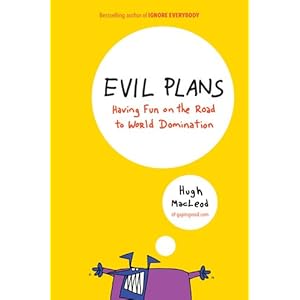
Book Review: Evil Plans by Hugh McLeod
 I've been a fan of Hugh McLeod for quite some time. It was my pleasure to review his last book, Ignore Everybody on my own, so I was excited when his publisher asked if I would review a copy of his new book, Evil Plans: Having Fun on the Road to World Domination. So with that having been said, here it comes:
 FULL DISCLOSURE: I was provided a review copy of the book free of charge by the publisher.
Evil Plans is a relatively short book. Don't mistake that for meaning it's not powerful and good, but it's short and concise, and I like that; I'm just saying that I was able to sit and read it in about 1.5 hours, which made it pretty easy to read it twice in the span of a single day. Additionally, it includes a good amount of Hugh's famous business card artwork, like the piece featured at the top of this post. What I like about him including the artwork strategically throughout the chapters is that the artwork now evokes a different set of information in my brain when I look at it; yes, I do have some of the prints that appear in the book, so I guess I'm one of the contributors, in my small way, to Hugh's realization of his own Evil Plan.
The concept of having an Evil Plan seems simple: your Evil Plan is that thing/idea that actually gets you out there to start doing what you love. Hugh goes through numerous examples and reinforcing ideas about the validity of Evil Plans and some tactics to get there while also asking some hard questions. However, don't mistake this as a step-by-step, how-to book: like most books of this vein, the idea seems to be to get you thinking differently with you filling in the tactical gaps of getting to the end result.
There are some great concepts in the book:
- "Middle-Seat Guy" -- focuses on how much the middle seats on airplanes suck and how you should avoid being the guy stuck trying to sell them in a world that doesn't want them.
- "Take the Cream Off the Top: Leave the Rest Behind" -- self explanatory. What would it take for you to do that in what you do?
- The Pressure to "Not Be Shit" -- you don't want to be shit, do you? Who does? We all have to deal with it and it's not going away; it's really whether or not hard is worth it.
- "Dinsoaurspeak" -- you're going to have to read the book for this one, but I like it. A lot.
One of the more resonating chapters with me was the Death by Stuff chapter and it goes something like this: if you love your stuff and not what you do, then you'll suffer "Death by Stuff", which doesn't seem like a fun way to live. When I was graduating college, I could have taken a high-paying consulting job and instead did something that I loved for half of the pay. The high-paying job would have put me in a fancy apartment with an expensive car, and I would've been playing that game of upgrading and getting more stuff forever without loving what I was doing at all. No regrets on my part when I look back. I think I'm one of the few (only?) people in my senior class that actually didn't take the expected path. And, yes, a bunch of them laughed at me. But recently I've not heard from any of them that they're loving what they're doing. Too bad for them, I guess.
I remember the "moment", as Hugh refers to it, of my first Evil Plan. When I was a senior in college and right before I graduated, a guy that I had been working with doing event security told me not to get into the business and not to get into entertainment. He then clarified the remark by saying that I shouldn't get into entertainment unless I could be at the top of an entertainment "pile". Evil Plan decided and I spent the last 10 years actualizing it. Worked hard, sacrificed weekends, nights, holidays, regular hours, normal jobs (see paragraph above), and higher pay (see paragraph above) to get there -- I slept rough and I was overextended and it was a blast. Oh, and I still do that because I'm doing what I love, and, frankly, as Hugh rightly points out, there's never been a better time to be overextended.
We'll see where my next Evil Plan comes from -- Hugh points out that you can't necessarily force that moment and that you'll likely not know that you reached the moment until after you've experienced it and are reflecting back. That's ok. I've done all I can do: I've decided to decide that there will be another.
Read the book. It's worth your time.
The book comes out on February 17, 2011.
PS -- Hugh's graphic at the top immediately made me think of that scene in Kung Fu Panda (yes, I have a 5-year old and it's a funny movie regardless) where his father tells him that the there is no secret ingredient to make the secret ingredient soup -- go see the movie if you have no idea what I'm talking about. The end point, and the reason that I bring it up, is that Evil Plans is a hell of a cookbook while the rest, of course, is just up to you. There is no secret ingredient. Or secret sauce, for that matter.
Sunday, January 30, 2011
The 4-Hour Body and lifehacking

When I read the 4-Hour Body (and, by the way, I haven't read all of it yet and am not sure that I ever will) it totally made sense to me: it's non-prescriptive on a lot of things. If you've read it and don't believe me, please provide me with the precise directions, timing, and exact dosage schedule for CQ based on what you read in the book.
The reason that 4-Hour Body made total sense to me is that its really a documentary of Ferriss hacking his life and specifically hacking his body. He tried a bunch of things, failed a bunch of times, documented the hell out of it, had some other people test some of the things he thought were duplicable, and distilled all of it into a book. If you're looking for a book that has the magic bullet of weight loss, ask yourself why it's the same book that also gives you ideas in how to expand your lung capacity so that you can hold your breath longer underwater. More to the point: if you're a woman, ask yourself why, after 4 weeks of the 4-Hour Body diet you're not getting the same results as guys that you know that are doing the same thing as you (if you ask Ferriss, he'll simply respond that for women and people over 40 it takes 4-6 weeks for the effects to happen ... because he's not a woman and he's not over 40 and can't experiment with that basis).
A lot of people out there are looking for the magic bullet and hoping for a diet book as prescriptive as Body for Life (hell, Body for Life even tells you what protein shake to use). Outside of the fact that 4-Hour Body is not just a diet book, I did the Body for Life thing, didn't like it, and give it up, which was an experiment/lifehack that didn't work for me. In fact, the thing that I hated the most about it was the fact that it was too prescriptive -- there was no real room whatsoever for experimentation.
For some reason folks think that 4-Hour Body is just a diet book and it's so much more than that. What 4-Hour Body comes down to is Ferriss using his previous success with 4-Hour Workweek to really get the idea of hacking your own body into the mainstream. Is this really all that new, though? I don't think so. The reality is that we hack out bodies all the time.
Ever tried smoking? How's that feel? Still do it or did you quit?
Ever drink coffee? Still do that? How many cups are you up to? Do you tell people how many cups it takes you in a day?
Let me give you an example from me: 5-Hour Energy I think is a great way to get an energy boost, but it contains niacin, which causes a flush on the skin of your face. Although over time the flush goes away, you can take an aspirin to mitigate the effect, so I used to tape aspirin to the tops of the bottles -- if you got a bottle from me, it had the aspirin taped to the top and you got a quick explanation from me why (kind of had to with an unidentified white pill taped with clear tape to the top of it). Did this mean that taking an aspirin before a 5-Hour was the only way to drink it? Nope. Will 5-Hour Energy even work for you? Maybe. It worked for me and a lot of other folks that I convinced to try it and a bunch of those folks followed my aspirin advice and didn't have a negative reaction. I know one person that gets sick to her stomach if she takes 5-Hour Energy, no matter what -- fine, don't drink it.
Let me ask you this (because you probably are still skeptical): do you hack anything else in the rest of your life? I bet you do. Easy examples are frequently found in how you manage your online presence. In my case I manage all of my e-mail addresses (including those on other domains) via my Gmail account for which I've purchased additional GBs of storage. Whether you know it or not, when you get an e-mail from me, it's come from a single inbox that I've hacked together to ensure that it always appears as though the emails are coming from the address to which you've sent them. In addition some of you have my direct cell number and some of you have my Google Voice number -- there's really no difference to you (Google Voice does call forwarding, voice forwarding, and voicemail), but you may or may not be actually calling my cellphone directly. Again, through a combination of Google Voice and PhoneTag, all of my voice messages come to my Gmail inbox and I process them from there. You may not have something nearly as complicated, but perhaps you have 1 e-mail address you use to sign up for stuff and 1 that you actually use for your friends ... kind of the same idea and your online life is part of your overall life these days, so believe it or not, your engaging in lifehacking.
Touching back on the 4HB diet: I got a lot of comments on my original post of tips and tricks. Why was that? Because I was adding my own hacks to the fat burning hacks that Ferriss put forth in 4-Hour Body. I believe that you can do equally well with the framework of the diet hacks he put together in both Indian restaurants and Mongolian BBQs. Does that make my hacks better or worse? Not at all. My hacks are just an improvement that work for me and might just work for you -- as many famously say: your mileage may vary.
If you don't like the fact that Ferriss recommend no fruit in his fat burning diet, then ignore him. Try it for a few weeks without fruit, try it for a few weeks with fruit, measure, document, and see what works for you. Don't like the fact that there are no grains in it? Experiment with it, hack it, document it, and go with what works for you -- you've got to live with it.
You'll make mistakes -- Ferris did. Don't believe me? Read his post of corrections (hint: turns out that the whole PAGG stack thing isn't really supposed to include the green tea extract before bed -- think PAG before bed instead of PAGG. Since I've been doing PAGG, when I cycle back on to the stack, I'm going to try PAG and see if there's actually a difference; otherwise I'll stick with PAGG because it hasn't been not working for me).
The real point here is that tinkering is ok. We find it easier to conceive of tinkering with other things that seem easier to tinker with instead of our bodies. For whatever reason we think that we should only allow those with exact prescriptions and rules and guidelines to provide input on how and what we should do to our bodies. It's not really easier to sit around and wait 10 years for the FDA to approve something before we try it -- sure there can be downside effects, but the body is pretty good at repairing itself; frankly the body is better at repairing damage done to itself than many of the other things that we hack around with.
I encourage you to get the background on things before you try them, just as Ferriss did (note that he encourages you to skip the back-up and background and medicine and science in the book if it doesn't appeal to you) -- get as much information as you can before you decide. Tony Robbins recommends: "If you want to master ANYTHING in your life, you just can't leave it to chance, you have to make it a study." So if you want to hack something, make it a study -- it's never been easier.
Good luck. Have fun.
Don't be scared to share.
Photo from manu contreras
Thursday, January 13, 2011
Make Gmail your only inbox by buying storage
80gb is only $20 a year and is shared between Gmail and your Picasa albums.
Worth thinking about -- check it out.
Worth thinking about -- check it out.
Subscribe to:
Posts (Atom)