Maybe you should watch this.
Link if the embed isn't working.
Monday, March 21, 2011
Direct-to-Netflix
After having just recently signed up for the Netflix streaming service, I began to wonder why it was that no one was producing content directly for Netflix. Turns out that I was just ahead of the Netflix announcement that they will be offering House of Cards with Kevin Spacey exclusively to their streaming subscribers in the US and Canada. This reminds me a lot of the Domino Project where Seth Godin partnered with Amazon to publish his latest book, Poke the Box.
It may not be the easiest thing to completely ditch your television service (yet), but when you're like Netflix and you're owning attention in front of the tv, it's easy to keep that attention by providing exclusive content that Comcast, DirecTV, and Dish won't have access to (it probably also helps you get new subscribers).
It may not be the easiest thing to completely ditch your television service (yet), but when you're like Netflix and you're owning attention in front of the tv, it's easy to keep that attention by providing exclusive content that Comcast, DirecTV, and Dish won't have access to (it probably also helps you get new subscribers).
Tuesday, February 22, 2011

Saturday, February 12, 2011
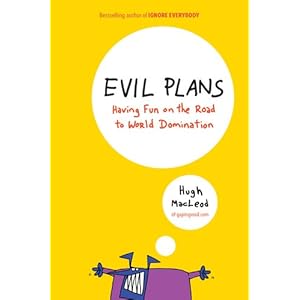
Book Review: Evil Plans by Hugh McLeod
 I've been a fan of Hugh McLeod for quite some time. It was my pleasure to review his last book, Ignore Everybody on my own, so I was excited when his publisher asked if I would review a copy of his new book, Evil Plans: Having Fun on the Road to World Domination. So with that having been said, here it comes:
FULL DISCLOSURE: I was provided a review copy of the book free of charge by the publisher.
Evil Plans is a relatively short book. Don't mistake that for meaning it's not powerful and good, but it's short and concise, and I like that; I'm just saying that I was able to sit and read it in about 1.5 hours, which made it pretty easy to read it twice in the span of a single day. Additionally, it includes a good amount of Hugh's famous business card artwork, like the piece featured at the top of this post. What I like about him including the artwork strategically throughout the chapters is that the artwork now evokes a different set of information in my brain when I look at it; yes, I do have some of the prints that appear in the book, so I guess I'm one of the contributors, in my small way, to Hugh's realization of his own Evil Plan.
The concept of having an Evil Plan seems simple: your Evil Plan is that thing/idea that actually gets you out there to start doing what you love. Hugh goes through numerous examples and reinforcing ideas about the validity of Evil Plans and some tactics to get there while also asking some hard questions. However, don't mistake this as a step-by-step, how-to book: like most books of this vein, the idea seems to be to get you thinking differently with you filling in the tactical gaps of getting to the end result.
There are some great concepts in the book:
- "Middle-Seat Guy" -- focuses on how much the middle seats on airplanes suck and how you should avoid being the guy stuck trying to sell them in a world that doesn't want them.
- "Take the Cream Off the Top: Leave the Rest Behind" -- self explanatory. What would it take for you to do that in what you do?
- The Pressure to "Not Be Shit" -- you don't want to be shit, do you? Who does? We all have to deal with it and it's not going away; it's really whether or not hard is worth it.
- "Dinsoaurspeak" -- you're going to have to read the book for this one, but I like it. A lot.
One of the more resonating chapters with me was the Death by Stuff chapter and it goes something like this: if you love your stuff and not what you do, then you'll suffer "Death by Stuff", which doesn't seem like a fun way to live. When I was graduating college, I could have taken a high-paying consulting job and instead did something that I loved for half of the pay. The high-paying job would have put me in a fancy apartment with an expensive car, and I would've been playing that game of upgrading and getting more stuff forever without loving what I was doing at all. No regrets on my part when I look back. I think I'm one of the few (only?) people in my senior class that actually didn't take the expected path. And, yes, a bunch of them laughed at me. But recently I've not heard from any of them that they're loving what they're doing. Too bad for them, I guess.
I remember the "moment", as Hugh refers to it, of my first Evil Plan. When I was a senior in college and right before I graduated, a guy that I had been working with doing event security told me not to get into the business and not to get into entertainment. He then clarified the remark by saying that I shouldn't get into entertainment unless I could be at the top of an entertainment "pile". Evil Plan decided and I spent the last 10 years actualizing it. Worked hard, sacrificed weekends, nights, holidays, regular hours, normal jobs (see paragraph above), and higher pay (see paragraph above) to get there -- I slept rough and I was overextended and it was a blast. Oh, and I still do that because I'm doing what I love, and, frankly, as Hugh rightly points out, there's never been a better time to be overextended.
We'll see where my next Evil Plan comes from -- Hugh points out that you can't necessarily force that moment and that you'll likely not know that you reached the moment until after you've experienced it and are reflecting back. That's ok. I've done all I can do: I've decided to decide that there will be another.
Read the book. It's worth your time.
The book comes out on February 17, 2011.
PS -- Hugh's graphic at the top immediately made me think of that scene in Kung Fu Panda (yes, I have a 5-year old and it's a funny movie regardless) where his father tells him that the there is no secret ingredient to make the secret ingredient soup -- go see the movie if you have no idea what I'm talking about. The end point, and the reason that I bring it up, is that Evil Plans is a hell of a cookbook while the rest, of course, is just up to you. There is no secret ingredient. Or secret sauce, for that matter.
Sunday, January 30, 2011
The 4-Hour Body and lifehacking

When I read the 4-Hour Body (and, by the way, I haven't read all of it yet and am not sure that I ever will) it totally made sense to me: it's non-prescriptive on a lot of things. If you've read it and don't believe me, please provide me with the precise directions, timing, and exact dosage schedule for CQ based on what you read in the book.
The reason that 4-Hour Body made total sense to me is that its really a documentary of Ferriss hacking his life and specifically hacking his body. He tried a bunch of things, failed a bunch of times, documented the hell out of it, had some other people test some of the things he thought were duplicable, and distilled all of it into a book. If you're looking for a book that has the magic bullet of weight loss, ask yourself why it's the same book that also gives you ideas in how to expand your lung capacity so that you can hold your breath longer underwater. More to the point: if you're a woman, ask yourself why, after 4 weeks of the 4-Hour Body diet you're not getting the same results as guys that you know that are doing the same thing as you (if you ask Ferriss, he'll simply respond that for women and people over 40 it takes 4-6 weeks for the effects to happen ... because he's not a woman and he's not over 40 and can't experiment with that basis).
A lot of people out there are looking for the magic bullet and hoping for a diet book as prescriptive as Body for Life (hell, Body for Life even tells you what protein shake to use). Outside of the fact that 4-Hour Body is not just a diet book, I did the Body for Life thing, didn't like it, and give it up, which was an experiment/lifehack that didn't work for me. In fact, the thing that I hated the most about it was the fact that it was too prescriptive -- there was no real room whatsoever for experimentation.
For some reason folks think that 4-Hour Body is just a diet book and it's so much more than that. What 4-Hour Body comes down to is Ferriss using his previous success with 4-Hour Workweek to really get the idea of hacking your own body into the mainstream. Is this really all that new, though? I don't think so. The reality is that we hack out bodies all the time.
Ever tried smoking? How's that feel? Still do it or did you quit?
Ever drink coffee? Still do that? How many cups are you up to? Do you tell people how many cups it takes you in a day?
Let me give you an example from me: 5-Hour Energy I think is a great way to get an energy boost, but it contains niacin, which causes a flush on the skin of your face. Although over time the flush goes away, you can take an aspirin to mitigate the effect, so I used to tape aspirin to the tops of the bottles -- if you got a bottle from me, it had the aspirin taped to the top and you got a quick explanation from me why (kind of had to with an unidentified white pill taped with clear tape to the top of it). Did this mean that taking an aspirin before a 5-Hour was the only way to drink it? Nope. Will 5-Hour Energy even work for you? Maybe. It worked for me and a lot of other folks that I convinced to try it and a bunch of those folks followed my aspirin advice and didn't have a negative reaction. I know one person that gets sick to her stomach if she takes 5-Hour Energy, no matter what -- fine, don't drink it.
Let me ask you this (because you probably are still skeptical): do you hack anything else in the rest of your life? I bet you do. Easy examples are frequently found in how you manage your online presence. In my case I manage all of my e-mail addresses (including those on other domains) via my Gmail account for which I've purchased additional GBs of storage. Whether you know it or not, when you get an e-mail from me, it's come from a single inbox that I've hacked together to ensure that it always appears as though the emails are coming from the address to which you've sent them. In addition some of you have my direct cell number and some of you have my Google Voice number -- there's really no difference to you (Google Voice does call forwarding, voice forwarding, and voicemail), but you may or may not be actually calling my cellphone directly. Again, through a combination of Google Voice and PhoneTag, all of my voice messages come to my Gmail inbox and I process them from there. You may not have something nearly as complicated, but perhaps you have 1 e-mail address you use to sign up for stuff and 1 that you actually use for your friends ... kind of the same idea and your online life is part of your overall life these days, so believe it or not, your engaging in lifehacking.
Touching back on the 4HB diet: I got a lot of comments on my original post of tips and tricks. Why was that? Because I was adding my own hacks to the fat burning hacks that Ferriss put forth in 4-Hour Body. I believe that you can do equally well with the framework of the diet hacks he put together in both Indian restaurants and Mongolian BBQs. Does that make my hacks better or worse? Not at all. My hacks are just an improvement that work for me and might just work for you -- as many famously say: your mileage may vary.
If you don't like the fact that Ferriss recommend no fruit in his fat burning diet, then ignore him. Try it for a few weeks without fruit, try it for a few weeks with fruit, measure, document, and see what works for you. Don't like the fact that there are no grains in it? Experiment with it, hack it, document it, and go with what works for you -- you've got to live with it.
You'll make mistakes -- Ferris did. Don't believe me? Read his post of corrections (hint: turns out that the whole PAGG stack thing isn't really supposed to include the green tea extract before bed -- think PAG before bed instead of PAGG. Since I've been doing PAGG, when I cycle back on to the stack, I'm going to try PAG and see if there's actually a difference; otherwise I'll stick with PAGG because it hasn't been not working for me).
The real point here is that tinkering is ok. We find it easier to conceive of tinkering with other things that seem easier to tinker with instead of our bodies. For whatever reason we think that we should only allow those with exact prescriptions and rules and guidelines to provide input on how and what we should do to our bodies. It's not really easier to sit around and wait 10 years for the FDA to approve something before we try it -- sure there can be downside effects, but the body is pretty good at repairing itself; frankly the body is better at repairing damage done to itself than many of the other things that we hack around with.
I encourage you to get the background on things before you try them, just as Ferriss did (note that he encourages you to skip the back-up and background and medicine and science in the book if it doesn't appeal to you) -- get as much information as you can before you decide. Tony Robbins recommends: "If you want to master ANYTHING in your life, you just can't leave it to chance, you have to make it a study." So if you want to hack something, make it a study -- it's never been easier.
Good luck. Have fun.
Don't be scared to share.
Photo from manu contreras
Thursday, January 13, 2011
Make Gmail your only inbox by buying storage
80gb is only $20 a year and is shared between Gmail and your Picasa albums.
Worth thinking about -- check it out.
Worth thinking about -- check it out.
Wednesday, January 12, 2011
The only thing good to come out of Book of Eli
I had the unfortunate displeasure of watching Book of Eli a few weeks ago -- it was really bad, though I do have a new low standard to compare other movies against.
However, as bad as the movie was, the silver lining was a product placement of Tour in-ear Monster Beats by Dre headphones. One of the most frustrating things that I've found with regular in-ear headphones, even nicer ones, is that the cords will inevitably tangle and fray by virtue of the typical cylindrical cable design. The Tour headphones, on the other hand, use a flat cable that can't tangle by the nature of its shape and that at least appears to be less subject to fraying.
 I've had a chance play around with the version of the headphones that includes the Talk Control functions (mic for handsfree calling, volume controls, answer/end call button, pause/play button) and have the following observations:
Note that there is a version that does not include the Talk Control functions that is less expensive if you're just looking for good headphones.
However, as bad as the movie was, the silver lining was a product placement of Tour in-ear Monster Beats by Dre headphones. One of the most frustrating things that I've found with regular in-ear headphones, even nicer ones, is that the cords will inevitably tangle and fray by virtue of the typical cylindrical cable design. The Tour headphones, on the other hand, use a flat cable that can't tangle by the nature of its shape and that at least appears to be less subject to fraying.
- Flat cables are a smart innovation -- it's easy to wrap them around the phone and easy to put them in the carrying case. Frankly, I worry less about putting these in a case due to the nature of the design.
- Sound quality is very good -- it is at least equal to my Shure in-ears if not a little bit better.
- I'm a bid fan of the foam and silicone blend tips -- you'll need to order the separate Monster tip kit to get the foam ones, but if you're looking for the best outside noise reduction and the best fit without having to use the over-ear hangers, the foam tips are probably the best option.
- The tips that come on the heaphones probably won't fit your ears -- unlike Shure and some other manufacturers, you're likely going to have to change out the tips, but they do include a good assortment of silicone tips for sizing (presuming you don't order the extra tip kit).
- You have to fully seat the jack in order for the Talk Control functions to work -- if it doesn't click in, you may still get music, but you won't be able to use any of the volume control or phone control functions. Although I don't use one, I tried it with an iPhone 4 that had a bumper and you do not have to trim the bumper to get it to fit.
- Although the manual says that the Talk Control is compatible with iPhone 3GS & 3G, all functions are working without problem on the iPhone 4.
- The right angle on the jack connector is great and makes the headphones feel much more low profile; the phone also sits better in a pocket either upside down or to the side without a large jack sticking out of the top.
- Warranty on these headphones is 3 years, which is better than most of the other manufacturers that usually offer a 1 year warranty.
- The headphones offer a sealed channel with a screen as opposed to an open tube that needs to be cleaned out. You wouldn't think this is a big deal, but I've had the open tube kind and it is not fun to try and clean them out when they get clogged.
- The microphone is noise canceling on the Talk Control model and seems to work pretty well; not at the level of a Jawbone, but pretty good.
Note that there is a version that does not include the Talk Control functions that is less expensive if you're just looking for good headphones.
Tuesday, January 11, 2011
My thoughts on the Verizon iPhone 4
The Verizon network tends to be stronger in certain places -- if it works better where you spend most of your time on the phone, you should think about switching.
A few points to think about:
If you are an AT&T iPhone 4 user and you did the upgrade last July, I do recommend that you do the research around what your early termination fee might be with AT&T and how best to settle out with them. A quick Google search showed me that AT&T has little sympathy/mercy for those that switch to another network mid-contract and they apparently will forward outstanding amounts to collections without hesitation.
A few points to think about:
- This is still a CDMA phone with no automagical chipset in it, meaning that you can't talk and do data activities at the same time. That may change as LTE rolls out and a new version of the iPhone is released, but as it stands with the iPhone 4 on Verizon, that's just how it is. If you're already a Verizon subscriber, you may already be used to this and it won't be a big deal to you, but if you're like me on AT&T with an iPhone 4, then consider this your fair warning.
- The mobile hotspot option is really cool. In general I've found that most of the places that I go, Verizon's 3G data network is faster and better than AT&T -- we use Mifi devices from Verizon for mobile data. I'm guessing, however, based on my first bullet, that when you are using the iPhone as a hotspot, you can't also engage in voice activities; not having played with the device, I'm not sure if it prioritizes voice over data, but if it does imagine serving up data to a few devices with your iPhone, getting a phone call, and knocking all of those devices offline.
- None of the specs for the Verizon version indicate SIM compatibility or a GSM radio, meaning that you won't be roaming on any overseas networks unless where you're traveling has a CDMA network. Perhaps not a big deal to many people, but worth thinking about -- note that AT&T's GSM network is the standard for most of the rest of the world, so international roaming on AT&T is really easy.
- Keep in mind what happened when all of those iPhone 3Gs rolled out on AT&T's data network. Verizon says they've been ready to handle the data consumption increase since 2009, but only time will tell if that's actually true. I hope it is for the sake of my Mifi.
- Some pictures floating around out there make it look like the switches on the side of the Verizon version got moved slightly, but noticeably on the left side of the device. If that is, in fact, the case, then you might actually need a different case than what fits the AT&T version -- worth thinking about if you've got some $$ invested in AT&T iPhone cases and are making the switch.
- Outside of the personal hotspot function, the iPhone 4 on Verizon doesn't appear to do anything that the AT&T version doesn't do. Most importantly, it runs the same iOS and functions from a software perspective in the same way, so if you don't like the iPhone experience on AT&T, you're not going to like it on Verizon either.
- The past iPhone upgrade cycle has occurred in the June/July timeframe and no one besides some folks in Cupertino really know what might be coming this year. It's impossible to look into the crystal ball and know if this year will bring a "S"-type upgrade that was done with the 3G, if we'll be looking at an iPhone 5, if any of the upgraded devices will be available on Verizon or AT&T or any other carriers, etc. Is there a possibility that an iPhone 5 will be released in July and that it will be available on Verizon? Sure, it's possible.
If you are an AT&T iPhone 4 user and you did the upgrade last July, I do recommend that you do the research around what your early termination fee might be with AT&T and how best to settle out with them. A quick Google search showed me that AT&T has little sympathy/mercy for those that switch to another network mid-contract and they apparently will forward outstanding amounts to collections without hesitation.
Sunday, January 09, 2011
Thursday, January 06, 2011
4-Hour Body: some diet tips & tricks into week 2

One of the notable things about this book's diet is that it's not necessarily prescriptive in the diet, but more general. For someone like me, I actually enjoy being able to figure it out with the 50,000-foot guidelines, but I've learned a lot of things in the past week-and-a-half that, at the behest of some folks that are also trying to do the diet, I'm going to share here. Note that I don't pretend to be an authority on the diet from this book and I may, in fact, be suggesting things that are less potent, not exactly in line with the guidelines, etc. -- everything that I suggest, however, seems to be working for me. And, as someone reminded me the other day with regard to the diet: "You have to be able to live with it."
So, without further ado, here are some things that I've learned (in no particular order) with regard to the diet portion:
- Odorless garlic caplets are about 95% odorless, which means that you get a lovely taste of garlic every time you pop one in your mouth. I recommend odorless garlic gelcaps -- they don't have any dust or taste at all, and I assume they are just as effective.
- The Athletic Greens product does allow you to stop taking multi-vitamins, but they don't have any Omega-3, so you'll want to take a fish oil supplement -- I recommend the Norwegian Gold as you only need to take one and I've never had a burping/taste problem with it. If you can get past the texture of it, Athletic Greens really isn't that bad and you'll be taking enough pills as it is if you follow the AGG/PAGG stack, so it's kind of nice to replace multivitamins with the drink. Note that Athletic Greens is a powder that you mix into water, so you want to use as little water as possible to make it go down more quickly and a taller, skinnier glass makes it easier to mix without clumps.
- All of the AGG/PAGG components are available at GNC, but I had better luck finding them more consistently at VitaminWorld -- not sure if this is just an immediate effect from the book coming out or if GNC in Denver just doesn't keep high stock in some of the items. Also, GNC does not have the odorless garlic liqui-caps.
- I wasn't able to find the exact probiotic pills that are listed in the book anywhere but the website in the book, but VitaminWorld and Amazon do have several probiotic supplement options, including at least 1 product that combines probiotics and prebiotics in the same pill. If you elect to take Athletic Greens, you are getting prebiotics and probiotics, but I'm also putting a probiotic pill on top of that and counting the Athletic Greens only for its prebiotic as suggested in the book. The point here is that if the Athletic Greens don't appeal to you, there are pill supplements out there that will provide both prebiotic and probiotics at once.
- I like the bright color of the GNC brand Alpha Lipoic as it differentiates it from the garlic softgels that I'm using, which are exactly the same size.
- Get a pill organizer for all your pills to help keep you straight -- I've got the cheap $0.99 one that they sell at the register at GNC or VitaminWorld that has 5 compartments: 3 compartments with AGG, 1 with PAGG, and 1 with a probiotic and Omega-3 pill.
- You're not going to eat enough. I wasn't really a breakfast eater, so my first breakfast of 5 eggs, 1/2 can of beans and salsa felt like an extraordinary amount of food, but I choked it down. Essentially you know you're eating enough if you're full and don't get really hungry in between meals (assuming that your doing a typical 3-meal diet).
- Chipotle is your friend. It's easy and quick and generally tasty. I do the steak fajita bowl with no rice, extra black beans, pico, green salsa, guac, and lettuce; if I'm really hungry, I do extra steak. Use the various flavors of Tobasco they have to change the flavors if you eat it a lot.
- Guacamole is heard to remember to get enough of -- if you have it on your burrito bowl at lunch, you've only gotten 1/2 of what you should consume in a day. The stuff you can buy at Costco is sealed fresh without preservatives and freezes -- you can get it from frozen to edible in about 5 minutes using the defrost setting on a microwave.
- Costco has a lot of fresh salsa and pico de gallo choices, but only a few are sugar- and preservative-free -- make sure you read the labels before you buy a bucket of salsa from Costco.
- Canned organic beans at Sunflower Market are the same price as the non-organic ones at regular stores. Example: Sunflower Brand black, organic, refried can of beans = same price as a can of Rosarita refried beans at Safeway.
- Low carb isn't as hard as you think at restaurants, but it is hard to find legumes. Examples: Brewery Bar III offers their fajitas with lettuce cups instead of tortillas, Taste of Philly Cheesesteaks will do any of their sandwiches on romaine instead of bread.
- Sushi is expensive when you're not getting rolls -- this to me is more of a cheat day thing where I'd go and gooblesashimi works very well for the diet.
- Get creative with food places. Examples: Yuan Place Mongolian BBQ where you can fill up your own bowls for them to cook means that you can just fill it with protein and vegetables (go at night when it's all you can eat) and at cajun places ask for the red beans and rice without the rice.
- Most nice steak places can easily do steaks with sides of broccoli and cauliflower and may even have some appetizers that feature guacamole, but I've yet to find one that actually has any sort of legume as a side.
- Lentils (known as "dal" or "daal") are a staple of Indian food and can generally be found as an inexpensive side dish to put along some tandoor-prepared proteins -- India's Castle is always my go-to place.
- Sugar-free Jello, as Ferris points out, can be helpful for cravings, but that stuff is almost sickly sweet. If you don't want to keep it around in a big bowl in the fridge, you can buy the individual cups of it at the grocery store.
- Cook lentils at home and they'll last you for about a week if you use a whole bag. Organic green lentils taste better and get softer than what you might pull off the shelf at Safeway. Prep is simple: put some butter in a pan, saute some garlic in it, pour in a box of beef broth (don't use the low sodium), pour in some Italian seasoning, let it boil to combine flavors, turn it down to medium and boil the lentils. In CO it seems like you need to boil the lentils for over a hour and you'll likely need to add some additional water throughout the cooking process. Once they cool, put them in a sealable container. in the fridge and heat them up as you need them in the microwave.
- Go buy some disposable tupperware/gladware -- good for leftovers, bringing portions with you, etc. and you won't care if you lose it.
- Hardboil some eggs. Lots of diets recommend this and there's a reason: it's easy, portable protein. Do it. Take 16 organic eggs, cover them in a pot with cold water, turn the heat on high, and time 10 minutes from when the water starts to boil. After 10 minutes, remove from the water and cool. Take the time when you're cooking them to remove the shells so that when you grab them from the fridge, they are ready to eat.
- If you're cooking eggs: use eggwhites with your regular eggs. For example, I might fry 3 organic eggs, but I'll pour in 1/4 cup of egg whites -- it tastes better (and apparently doesn't smell as bad in the house).
- Costco sells 85/15 organic, grass-fed beef in 3lb packs -- get a pack, make 6 8oz burgers and leave them in the fridge. You'll eat them in a week.
- Costco sells bison in 2 1lb packages -- get some, it's good.
- Some places sell ground lamb meat -- different tasting burgers, good to mix with beef, or try this: saute some onions and garlic in some butter and brown the lamb meat in it, add in cooked lentils at the end just to bring them to temperature, and serve over steamed or baked cauliflower.
- Lentils produce less gassy effects than beans. That's just how it works. I don't know why, but I eat more lentils when I can.
- On your cheat days, you're not wasting calories, you're wasting fullness. In other words, if you would be happier having 2 Big Macs and fries for lunch as opposed to some custom sandwich that costs a lot more, may not be as satisfying, and reminds you a lot of what you're already eating on the diet, then have the Big Macs.
- Watch out for hidden sugars in sauces. This is especially true in Chinese restaurants where healthy-seeming things are not really diet friendly. Hints: black-bean sauce does not mean legumes and beef with broccoli generally has a ton of sugar in it.
- Truvia isn't very prevalent yet -- if you need to add sweetener to things, get a box of it at Costco and carry the packets with you.
- Mexican food stores and carnecerias are generally the best places to find the cheapest avocados; if you're not comfortable with that, buy the big bag of them at Costco and let them ripen in your house.
- Take advantage of the fact that you can have a glass or 2 of red wine. Try out Chilean and Argentinean red wines -- generally there are some pretty good offerings at lower prices.
- Eat out at places where it's not obvious that you're on a diet. Case-in-point: went to a place where I thought I had slyly ordered a burger without a bun and a side of refried beans and when the plate came, let's just say that there was a lot of white space on it, which made the person sitting with me uncomfortable/embarrassed by what he had ordered because it looked so massive in comparison (note that if I go to that place again, I'll be ordering the double burger without the bun to (1) fill up the plate, and (2) get enough protein).
- Don't weight yourself. Your weight bounces around all over the place, especially after cheat days. Take pictures, use measurements, whatever, but don't count on the scale to give you the true story. The most telling thing for me is how loose my pants are getting at the waist.
- Use something to keep track of what your eating and stacking. I never used to do this, but I'm using PBworks to do this and it's shared with my wife, so she can update her participation as well. You don't have to be all high-tech, but writing it down makes a difference and creates accountability.
- If you're going to drink the yerba mate tea, I recommend the chai spice flavor.
- If you think Starbucks coffee tastes burned (like I do), then get an Americano (that's what the barista told me) -- as long as you don't dump sugar and cream and stuff into it, the Americano works the same way as coffee. Apparently an Americano is a shot of espresso with water added to it, so the upside is that you can add to the caffeine by adding extra shots, which you can't do with the standard brew.
- Drink lots of water -- I like using 1 liter bottles of SmartWater as my bottled water, and it has potassium in it, which you may find yourself deficient of on this diet, so it's not a bad source for a little extra and Costco frequently has the cases on sale. If you add lemon to you water it makes you pee a lot more and both this book and others that I have read suggest adding some citrus, especially on your cheat day.
Friday, December 17, 2010
How to learn about giving through the actions of a 5-year-old
It didn't start out as charity.
It started out as a 5-year-old girl who wanted a present for Christmas many weeks in advance of the holiday.
The deal we made with her was that she was to save up the money herself for an American Girl Doll (I believe she may actually have been told that Santa doesn't bring American Girl Dolls, but that's not relevant to the story). So for about 5 months our daughter saved up her money to purchase an American Girl Doll -- she saved her allowance, she did extra chores for extra allowance, and she even tried to get creative with the change from purchases that she made with our money. A few weeks ago she had saved up $97.00, only $3.00 short of the approximate $100.00 that it takes to get one of the dolls with tax.
Before she got so close to her goal, I had been listening to some Anthony Robbins tapes. I'll paraphrase one of his keys to wealth and happiness with the following 3 points:
In thinking through it a little more, we decided that we needed a little bit more of a carrot for our daughter, so I proposed that we match her nearly-$100.00 with $100.00 of our own money (in cash, of course) for her to buy a second doll, but that she had to also give that doll to someone in the hospital. Remember that as you get older, it's easier to follow Robbins' advice, but for a 5-year-old that has saved for many months, the prospect of giving up all that hard-earned money was likely to be a bit of a challenge.
So, armed with the plan, we took our daughter out to lunch and near the conclusion of her cheeseburger, we simply threw out the idea of her buying a doll for a girl in the hospital with her money. Her initial reaction was that she wanted to use her money to buy herself a doll at Christmas and then she would save to buy another doll for a girl in the hospital -- a pretty remarkable response from someone so young, if you think about it. We spent some more time explaining to her about how there will people in need and that it wouldn't be any fun to be in the hospital at Christmas. Then we threw the offer of the matching funds out there and pointed out that because Santa was paying extra attention this time of year, she could score some major "nice list" points. After weighing that internally, the 5-year-old got pretty excited -- she was on-board.
Due to the nature of the timing of everything, my wife took my daughter to the American Girl store to pick out the 2 dolls. While there, our daughter took the opportunity to inform the manager of what she was doing -- apparently the manager almost cried.
Following that, my wife posted the following on her Facebook account:
We've been in touch with the Children's Hospital and our daughter will be delivering everything during the middle part of next week, so that the families of the kids that will receive them will have them in-hand prior to the holidays.
Thanks to everyone for your generosity and willingness to participate in not only the worthy spirit of giving with no expectation of anything in return, but also in teaching our daughter an important lesson.
PS -- if you find yourself inspired to participate in giving something to someone, I certainly hope that you do. If you find yourself particularly inspired to participate with us, and that certainly wasn't the point of this post, just shoot me an e-mail (I'm easy to find) and I'll let you know how you can participate with us.
It started out as a 5-year-old girl who wanted a present for Christmas many weeks in advance of the holiday.
The deal we made with her was that she was to save up the money herself for an American Girl Doll (I believe she may actually have been told that Santa doesn't bring American Girl Dolls, but that's not relevant to the story). So for about 5 months our daughter saved up her money to purchase an American Girl Doll -- she saved her allowance, she did extra chores for extra allowance, and she even tried to get creative with the change from purchases that she made with our money. A few weeks ago she had saved up $97.00, only $3.00 short of the approximate $100.00 that it takes to get one of the dolls with tax.
Before she got so close to her goal, I had been listening to some Anthony Robbins tapes. I'll paraphrase one of his keys to wealth and happiness with the following 3 points:
- Give with no expectation of receiving anything in return; do it because it feels good.
- Give when its hardest for you to do so -- when it's hardest is the best time to give.
- Give away a percentage (10% is what he recommends) of your money to reset your brain that there is actually enough.
In thinking through it a little more, we decided that we needed a little bit more of a carrot for our daughter, so I proposed that we match her nearly-$100.00 with $100.00 of our own money (in cash, of course) for her to buy a second doll, but that she had to also give that doll to someone in the hospital. Remember that as you get older, it's easier to follow Robbins' advice, but for a 5-year-old that has saved for many months, the prospect of giving up all that hard-earned money was likely to be a bit of a challenge.
So, armed with the plan, we took our daughter out to lunch and near the conclusion of her cheeseburger, we simply threw out the idea of her buying a doll for a girl in the hospital with her money. Her initial reaction was that she wanted to use her money to buy herself a doll at Christmas and then she would save to buy another doll for a girl in the hospital -- a pretty remarkable response from someone so young, if you think about it. We spent some more time explaining to her about how there will people in need and that it wouldn't be any fun to be in the hospital at Christmas. Then we threw the offer of the matching funds out there and pointed out that because Santa was paying extra attention this time of year, she could score some major "nice list" points. After weighing that internally, the 5-year-old got pretty excited -- she was on-board.
Due to the nature of the timing of everything, my wife took my daughter to the American Girl store to pick out the 2 dolls. While there, our daughter took the opportunity to inform the manager of what she was doing -- apparently the manager almost cried.
Following that, my wife posted the following on her Facebook account:
I am so proud of my 5 year old kiddo. She saved up all year to buy an American Girl doll....and when she finally had the $100...she decided to buy the doll and donate it to Children's Hospital of Denver. We matched her donation so next week we will deliver two American Girl dolls to the hospital and hopefully give them directly to two little girls. I'm speechless that I have raised such a cool kid.And following that, others that wanted to participate started leaving messages. I started telling the story to people as well ... and they started handing me cash wanting to participate. So, at this point -- we're at 7 dolls and counting (not including the $100.00 that was provided by someone for a gift for a boy).
We've been in touch with the Children's Hospital and our daughter will be delivering everything during the middle part of next week, so that the families of the kids that will receive them will have them in-hand prior to the holidays.
Thanks to everyone for your generosity and willingness to participate in not only the worthy spirit of giving with no expectation of anything in return, but also in teaching our daughter an important lesson.
PS -- if you find yourself inspired to participate in giving something to someone, I certainly hope that you do. If you find yourself particularly inspired to participate with us, and that certainly wasn't the point of this post, just shoot me an e-mail (I'm easy to find) and I'll let you know how you can participate with us.
Thursday, September 23, 2010
10 things to help your fear of public speaking

What's funny is that I had been asked to give a brief presentation on a topic that I knew very well: how our side of the business was making such great numbers in food and beverage. I knew the topic well because I was the head of the national initiatives that were driving the numbers -- such a slam dunk, I didn't really even think about it; big mistake. When my turn finally came, my presentation was lame, it was actually downright embarrassing. I was sweating and shaking and even tried to get away with not using the mic. Instead of covering off on the great things that we were doing, I offered 3 minutes of lame verbal presentation with no props, no slides, no nothing -- big mistake on my part and I know I came across as incapable; certainly not the guy that was actually producing the results.
After that horrible presentation, I resolved to never, ever be unprepared and also to never allow myself to get that intimidated in a presentation ever again. I went and bought books, I was lucky enough to see some great presentations live, I scoured the internet for presentation secrets.
If you're looking for the silver bullet here, you're not going to get it, but I will tell you what helped a lot.
First: you've got to get out and do it; practice, like with anything else, is what makes you better at the presentation. I'm sure you've heard it before, but not practicing public speaking means that you won't be any good at it at all when you finally need to do it. You don't have to go from nothing to groups of hundreds or thousands, just use every possible opportunity to get out there and do it, even if it's only for 5 minutes.
Second: understand the psychology of it. There are lots of books out there that deal with this, but no one sums it up better than Seth Godin in Linchpin: "It turns out the three biological factors that drive job performance and innovation are social intelligence, fear response, and perception. Public speaking brings all three together. Public speaking also triggers huge fear responses. We're surrounded by strangers or people of power, all of whom might harm us. Attention is focused on us, and attention (according to our biology) equals danger. Last, and more subtly, speaking involves perception. It exposes how we see things, both the thing we are talking about and the response of the people in the room. Exposing that perception is frightening. In a contest between the rational desire to spread an idea by giving a speech and the biological phobia against it, biology has an unfair advantage." Once you know all this and acknowledge it, you can confront it and move on (or not). As Godin later points out: "Anxiety is needless and imaginary. It's fear about fear, fear that means nothing." What you "fear" about public speaking is the fear of everything listed above. As I ask others that I coach through this stuff: "What's the worst that's going to happen? They'll laugh at you or walk out -- who cares?"
Third: talk about stuff your passionate about. This is really simple. If you don't present and talk about things you feel strongly about, feel passionate about, you'll fail. I don't care how well you speak, there's a genuine (detectable) difference between just speaking at people and truly trying to get the message across about something your passionate about. As Tom Peters says, "People can smell emotional commitment (or lack thereof) from a mile away."
Fourth: set the room. Don't ever let some conversion guy, tech guy, event planner, etc. to set the room so you're not comfortable with it -- show up early and be ready to get dirty moving stuff around. Try to plan ahead and tell whomever is setting the room what you want (and then expect them to not do it quite right and that you'll need to adjust it).
Fifth: develop some rules for your PowerPoint presentations. If you're going to use them, adopt a formula and stick with it. I like Guy Kawasaki's 10/20/30 rule of PowerPoint (with some variations) and Seth Godin's Really Bad PowerPoint, but I can tell you that I don't have a presentation that violates the rule of text smaller than 20 point text and that the majority of my slides are pictures/graphics/video and no text at all. Spend money on stock photography and graphics, and make sure you buy the correct license to use in your presentation. Either make your presentation look good by buying the graphics you need or stay home -- no one wants to see stupid built-in clipart from Microsoft. Sorry to bum you out, but it's the way it is.
Sixth: get used to the damn microphone. Get used to holding one, get used to walking around with one, get used to getting one attached to your lapel, and, if you're speeching a lot, go buy your own mic that can go in the wireless transmitter (the Samson SE50 is a place to start). By the way, if you're wireless, make sure you have 2 sets of spare batteries for the wireless mic or belt pack. Why 2? Because the mean failure rate jumps to 99.99% when you're presenting in front of a group and you can add more 9's to the left of the decimal the larger the group is.
Seventh: you're going to lose your train of thought. Get used to it and learn how to work through it. Or don't an fail. The natural reaction when you lose your train of thought is to go off on some tangent that makes no sense, but still causes words to come out of your mouth. Stop it! Figure out a method. I pick a person close to me, point at them, and say: "Shit! I lost my train of thought! What was I about to say?" They have no idea, but it jars my brain enough to get me back on track (or jars the audience enough that I don't have to).
Eighth: get audience interaction. For the love of god, people glaze over after five minutes. If they're not interacting with you, it's a lost cause. Unless you're talking for less than five minutes, in which case you might be ok, but you're probably better by getting them involved.
Ninth: dress the part. I hate wearing coats. I wear them during presentations ... usually with jeans. Why? It sets your frame of mind, it sets a tone with audience. Plus, if you're sweating your ass off, it ensures that the audience sees no wet pits (others won't tell you why they wear coats, I'm happy too -- wet pits suck, cover them with a jacket).
Tenth: there's a wealth of videos of great presenters available for free on the internet. Think what you want about Tony Robbins, but the guy knows his shit when it comes to presenting -- check out the TED video where he recovers from Al Gore shaking his train of thought. Check out a bunch of the TED videos -- hell, I post one almost every day on my Twitter feed; if you don't like the content, pay attention to the quality of the presentation.
I hope you do great.
Send me a link to video.
(picture from kevin_cease)
Thursday, September 16, 2010
20 minutes a day
I'm guessing you have it.
If you don't have it I'm guessing you can find it.
The TED (Technology Entertainment and Design) conference is held annually and costs $6,000.00 per year -- even if you can afford that, you still have to apply for membership, so coming up with the money is not a guarantee of entry. One of the defining characteristics of TED is the amazing speakers that they have; each speaker is limited in presentation time to about 18 minutes.
Although I could fill an entire blog post about TED and what they do and the spin-off conferences and everything else, here's what's important: all of these great presentations by amazing people are videotaped and made available free of charge on the TED site.
How better could you spend 20 minutes of your day in expanding your range, becoming a little smarter, and or learning something you had no idea about before?
I've been tweeting (you can follow me by clicking here) videos that I enjoy for the last several days and the response has been overwhelming; bear in mind that these are just videos/presentations I've enjoyed enough to share.
For those looking to get caught up, here are some of my recent top picks:
Trust me -- find 20 minutes a day.
Saturday, August 21, 2010
The next big ancillary revenue source in broadband
They'll be charging you to prioritize particular types of traffic.
Already have the standard $50 package from Comcast? If you're a gamer, pay an extra $15 per month and they'll prioritize that traffic for you.
Trust me, it's coming -- just selling raw speed isn't enough incremental revenue.
Already have the standard $50 package from Comcast? If you're a gamer, pay an extra $15 per month and they'll prioritize that traffic for you.
Trust me, it's coming -- just selling raw speed isn't enough incremental revenue.
Sunday, July 18, 2010
GleaSkins for the iPhone 4
 If you're like me, putting a bulky case on your iPhone 4 is the last thing that you want to do, but you probably still are looking for a little protection for the back of it (perhaps something to give it a little less slickness) and maybe even something to cover the antenna area to deal with those antenna issues.
Although I've got some other similar products on order, GelaSkins were the first 3M-based skins that I received -- the 3M material uses a web matrix to prevent bubbles and is repositionable; if you've ever tried to put on a screen protector only to have it not line up or get filled with air bubbles, this is the opposite of that experience.
Right off the bat when I opened the GelaSkins envelope, I was impressed with the clean and minimal packaging -- the GelaSkins kit for the iPhone 4 includes a cover for the full back with a cut-out for the camera, a cover for the left side with cut-outs for the mute button and volume buttons that extends to just shy of the mic, a cover for the right side with no cut-out for the SIM slot that extends to just shy of the speaker, a cover for the top black portion on the front with cut-outs for the camera and speaker, and a cover for the bottom black portion on the front with a cut-out for the navigation button. Applying the material was surprisingly easy and it is extremely forgiving: if you get off on the alignment, simply peel up the edge and don't worry about bubbles or loss of adhesion.
Initially I installed all of the cover pieces and even downloaded the matching wallpaper for the front -- GelaSkins sells artist-designed covers and has matching wallpapers that can be downloaded to give a consistent graphic appearance when the screen is turned on (I actually downloaded the GelaSkins iOS app). Upon using the phone with the front covers, I found that I didn't really like them, so I took them off and switched back to my original wallpaper.
I will admit that I haven't stress-tested the covers on the back and sides yet, but the small bit of cover over the antenna does seem to make some amount of difference on antenna performance. I'm not sure if it helps, but once I had the covers where I wanted, I left my phone alone in its overnight cradle to let the adhesive cure a little bit (note that the covers are designed to be removed at any time with no residue, so "cure" may not be the most correct term).
Note that although there are others out there offering similar products made from similar materials, GelaSkins does some to offer by far the coolest designs for skins.
More to follow after I've used it and let it bang around in my pocket for a couple of weeks.
Friday, July 16, 2010
The part of the job you love
 Do you remember why you started doing what you do? Aside from those that absolutely do what they do because of the money, chances are good that you at least started doing what you do because there was something about it that you loved. So here comes the second important question: when's the last time you did the part that you loved?
I hope it hasn't been too long.
My job is in entertainment -- I turned towards this full-time after graduating college and haven't looked back. What I love is being at the events, working with fans directly, getting into the middle of things, so I do. Interestingly, people other than my team members notice -- I recently had a conversation with a concert tour security guy that told me he knew our company had to be good because I was out on the ground with our staff . . . this was before the event even started and we hadn't worked with him before.
Some people find it weird: "How come you're out here doing this?" is a question that I frequently receive. I do it because I love doing it; if I stop loving it, I will likely stop doing it. That simple, that clean, that easy.
I worry a lot about people that don't like their jobs, the people that complain about "cases on the Moooondays", about reaching the hump day, those that watch the clock every day until it swings around to shift end, those that feel like they've been released from jail every Friday. There was a reason (usually other than money) that enticed you into the job to begin with, the part of it that you loved -- I would challenge you to go find that again and start spending your time doing that instead of focusing on all the stuff you don't love . . . or I challenge you to leave and go do what you love.
Is what you're doing worth doing? Is what you're doing what you love?
If it's not, how hard would it be for you to stop?
PS -- if you don't want to just believe me, Seth Godin's got a post with similar ideas.
PPS -- for those of you that find it hard to believe that anyone can actually pull off working and doing what they love, I submit to you this video from just a few weeks ago where you can find me in the barricade just stage left of center. You can also find me dead center of the camera in this video.
Friday, June 18, 2010
The office
 I remember when I worked for a large company and we were trying to come up with ways to maximize EBITDA -- my idea was to not renew our office lease; $90,000.00 direct to the bottom line by not really doing anything except not coming in to work. The idea, of course, was meet with resistance by a bunch of people, including people working in the office and people at the corporate office. What was interesting, of course, was that everyone already had laptops on their desk, all of the files were stored on servers in the corporate office, everyone had VPN access, and we had installed a very expensive phone system with IP and soft-phones; in short, we were totally set up to not be in the office, except no one wanted to be without the office.
Offices used to be where all the "stuff" was -- the computers, the servers, the phone system, the only way to check e-mail . . . that is no longer the case (do you remember when IT finally "turned on" Outlook Web Access) and it hasn't been for a while. It used to be that the only way the "watercooler conversation" happened was actually at the watercooler in the office, but now, of course, those conversations (and those that would likely never have occurred at the watercooler) take place on Facebook and instant messaging, faster and more dynamically and without having to get up from your chair.
Interestingly I compose this post from the patio of a place down the street that has wifi . . . because the power to our office complex is completely out and the power company is optimistic on the fact that it will be turned back on "at some point today". In the context of this post:
- Our e-mail and groupware services are through Google Apps -- wifi on the patio is as good as ehternet and wireless in the office.
- Our users store their files locally because they are constantly backed up and version-controlled when machines are idle for 10 minutes by Mozy Pro -- the file server is not a concern.
- The telephone/internet provider that we use allows us to software-forward the main office line to a cellular phone or other number if needed -- taken care of via a web portal.
- Most of our employees use their cell phones as their primary business phones anyway -- no disruption with the phone system being down.
- Our website is hosted with BlueHost.
- Our workforce management software is hosted and delivered via thin client.
- Our payroll system is hosted and delivered via thin client.
- We use Basecamp for a number of collaboration projects, but could easily scale it to a bunch of others -- Basecamp is hosted an accessible from anywhere.
- The only thing that we cannot reliably access is our accounting software, which is the only item that we continue to host on our server as opposed to in the cloud -- maybe I need to re-evaluate this.
Seth Godin has a more detailed and general post about offices that's worth reading: link. In his post, Godin describes the linchpin to the death of the office simply being the "place to go" -- this is by far the easiest piece. If you are a client service organization, and your client has a facility, go work there and meet there -- hopefully your client(s) like you and would be happy to see you and your team more often. Panera's had free wifi for as long as I've been going there; some of them even have cool lobby areas outside the store. Starbucks has free wifi starting in July; think of the coffee fees as your utilities (you'll probably get better productivity with everyone all cranked up on caffeine anyway). Invest in 3G/4G wireless cards -- 10 employees x $60 per month = $600 (how much is your rent and phone service monthly now? for that matter, how much is your T1 per month) and pick a cool place or places. Find a few places that are smart enough to offer wifi (see my post about this here) as part of their value proposition -- maybe negotiate a deal to be able to "put it on your tab" because everyone wants to feel like a regular somewhere and be able to say that to impress clients, employees, and prospective clients. Let your employees actually work from home sometimes -- you don't need to see them face-to-face to measure productivity; some of them will take advantage or freak out, but they're not the ones you want long-term anyway.
Is this scary stuff? Maybe. But why are you scared?
Perhaps more importantly: how much higher could your salary be if the company didn't have to pay rent and utilities and monthly charges at the office? How much would you save on your commute? How much more productive could you be if your face-time with your co-workers was finite every week?
Still scared?
PS -- I haven't been successful practicing what I'm preaching here . . . yet.
PPS -- In the picture she's not passed out on the keyboard, she's just hiding from the camera. But when's the last time your office looked like that?
Tuesday, June 15, 2010
iPhone 4 purchasing today
A few tips and tricks for ordering your iPhone today based on my experience if you're an existing AT&T customer:
- If you're an existing AT&T customer, try using ATT's site instead of Apple's.
- Go to the AT&T store if the online is not working for you. If there is a long line, ask to manually fill out an upgrade form (they have them), let them make a copy of your credit card and driver license, and have them fax you confirmation once they've entered it into the system.
- Try accessing the AT&T site via your iPhone's Safari browser (don't use the AT&T iPhone app, but actually access it using Safari). I don't know if this is just coincidental, but when it wasn't working on my computer, it worked on my iPhone.
- Don't call the AT&T store -- they can't and won't take your order over the phone.
- Don't call the Apple Store -- they can't and won't take your order over the phone.
- White iPhone 4s are not available for pre-order from any outlet at this point.
- According to everything on all of the sites and in the store, your order should ship in time to arrive on June 24 -- be sure to use a shipping address where someone can receive the package or be sure to put a signature waiver out for the delivery guy.
Saturday, June 12, 2010
Digital kid
 My daughter started using an iPod Touch just short of age three -- somewhere a bit past two and a half. We didn't have to restrict the internet because she didn't really know how to spell and didn't care about the browser working -- just being able to type and click icons and have it play songs and videos was enough. Of course, this is unfathomable to people that grew up not watching television until they were ten or in their teens; people that maybe had a single house phone growing up.
At nearly 5 years old she's now on to the most current version of the iPod Touch. Although she hasn't done it herself (though she probably could if I let her play around with it), she's selected the music that's on it (based on recognition of the covers in coverflow, not necessarily the names of the bands/songs) and she's selected the videos that are on it (movies and television shows, including every episode of Phineas and Ferb with the commercials edited out). Through the App Store she has selected several games that she enjoys playing and she's got some amount of understanding about how YouTube works; interestingly the Notepad is one of her favorite applications right now as she loves to practice her spelling.
Even though she hasn't specifically complained about the lack of voice functionality, she refers to the iPod as her "phone" (just like the iPhones that both of us have). One of her favorite things, if she gets her hands on one of our phones (believe me, navigating the password locks for her is not a problem) is to use the camera -- clearly this is going to be an issue if the next generation has a camera and she sees it in the Apple Store. There are some apps that she seems to want, but thankfully, although she's able to get all the way through the purchase process on the App Store, she's yet to learn that password, so we haven't yet seen any massive App Store bills.
There's an interesting dynamic in discipline that goes along with the digital kid: the removal of apps and/or audio/video content can be powerful sticks or carrots. Given the fact that all of the apps and content are backed up in iTunes, digital discipline is easy to execute and even easier to reverse as appropriate.
It's hard to imagine that she'll be telling the "when I was kid when only had iPod Touches with wifi" conversation with her kids, but she probably will. And in that vein, here goes a few of my "when I was your age" for her:
- One phone in the house -- didn't get my own line until I was 13. Now we don't even have a home phone; when you need to talk to someone you either do it via video iChat or use one of our cellphones. Chances are good that you'll have your own cellular voice device at a pretty young age.
- Apple II was the computer that I grew up with; I got a Mac when I was 11 or 12 and the processor in that Mac is less powerful that the one in your iPod Touch. You currently have access to more raw computing power in our house than they use in the space shuttle.
- Until college, the most sophisticated device on my belt was a pager and it didn't have a keyboard. The phone device that you know how to use has the same functionality as my pager and it's considered an extremely minor feature at the bottom of the list behind a million others.
- Once I got my own phone line at age 13, I got a modem and was able to dial in to the internet at 14.4kbps to a local university that gave out free dial-in accounts; Mosaic and Netscape browser (the visual web) didn't come out until I was 15. You have access to the visual internet, streaming audio, streaming video, and all of it comes to the house where it's available wirelessly at a connection speed of 5mbps to the internet and 100mbps on our internal network.
- I had thousands of CDs (they look just live DVDs) and eventually got a player that allowed me to load multiple CDs at the same time. The music collection at our house is over 30,000 tracks and you can load a ton of them on your iPod, listen to them in any room of the house, and there's nearly unlimited storage for more.
As Seth Godin said in his recent post: "I saw a two-year old kid (in diapers, in a stroller), using an iPod Touch today. Not just looking at it, but browsing menus and interacting. This is a revolution, guys."
Sooner or later I'll be lame and behind the times and not understand what new technology she's into. For now I'm happy to be able to write about it.
PS -- the first thing she said when she saw my iPad: "Is that for me?"
Sooner or later I'll be lame and behind the times and not understand what new technology she's into. For now I'm happy to be able to write about it.
PS -- the first thing she said when she saw my iPad: "Is that for me?"
An opportuntiy for car transporters
 It seems like I've noticed a lot more car transporters on the road these days -- you know the ones I'm talking about: double-decker, open sided trailers being towed by a big rig. I've never really understood how it is that these companies can minimize damage to the cars and vehicles that they are carrying when they are exposed to weather and road damage; new cars have some plastic wrappings over what must be the most commonly damaged areas, but I have to imagine there is an expense to dealers for transportation rehab.
 Although I don't live in an area that has dock space or boat storage yards, I am well aware of the practice of shrink-wrapping boats for transportation and storage during the winter. Chances are good that you've seen boats in storage this way if you live in a cold weather coastal city or that you've even seen boats at dealerships with full or partial wraps to protect them while on the boat lot (I'm actually not sure if it's called a lot when it's not a car lot, but I'm sure you get the picture).
At this point it's likely you can see where I'm going with this: be the only auto transport company that shrink wraps the vehicles that it transports just like you shrink-wrap a boat. I don't have any idea what the cost of the shrink-wrap materials and time is, but I would be willing to bet that you could charge some sort of premium; perhaps it's low enough that you can charge the same price and make that your differentiating sales tactic. The one time I had a vehicle I already owned transported, it was on the bottom of a double-decker and something from the car above it dripped on it and chewed up the paint; it's possible that the shrink-wrap could have prevented this.
Just an idea -- free of charge from me to you.
I hope somebody implements it.
Car transporter image from sittered; wrapped boat image from Gemma Grace
Subscribe to:
Posts (Atom)