Tuesday, February 26, 2008

Here's what my iPod should do


ipodI was thinking this morning as I was pulling into my office parking lot that the iPod I was listening to in my car should some how be able to automagically tell my computer exactly what song I was listening to, exactly where I stopped in that song, and start playing that song when I walked in the door.   Is that realistic?


Let me answer that in a few ways:


  • Basic iPod -- seems like I should be able to take a basic iPod in with me and the very first thing it should transmit is the data I described above and my computer should start right where I left off.  Low tech, but functional and seemingly achievable.

  • iPod Touch -- if I were in range of my work wifi network and I turned off the car, the iPod should wirelessly transmit that data to my computer; if there's no wifi network, then it should work the same as the basic iPod.

  • iPhone (I'm sure you can see where I'm going with this) -- should use wifi or the data network to notify my computer.


Are there potential problems with this?  Sure, especially if the computer it's trying to notify doesn't have the music on it, but that's a pretty simple test.  In thinking more about it, my guess would be that it would probably be easiest to implement this in an iPhone if someone could figure out how to have the iPhone auto-trigger an e-mail that then triggered an automator response once received by the machine.  That's kind of kludgy though, and it would be much cooler if iTunes was the black box for this process. 


Sunday, February 10, 2008

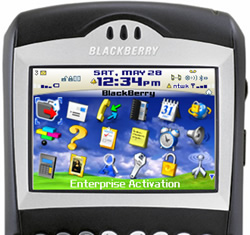
Add browser shortcuts to your applications on your BlackBerry


blackberryYup, pretty much just like the iPhone, but a little bit more complex.


Here's how:


  1. Go to this site

  2. Either type the over-the-air URL into your BlackBerry browser, use the Google Send to Phone site to SMS the OTA URL to yourself and copy and paste it into your BlackBerry browser, or download the installer to use with Desktop Manager (super-lame choice).

  3. Using the OTA method: download the "Shortcut Hub Utility" and at least "web shortcut 1"

  4. Open the Shortcut Hub Utility

  5. Define the URL and image URL -- images must be 32 pixel by 32 pixel PNG files (leave the background blank for best display) and here's an example that I made for Grand Central.


A few notes:


  • The default for the image is "http://", so if you don't change this, it goes into an infinite loop looking for the logo to download.  I believe if you blank this out, it should work

  • This would probably be very useful for deploying corporate websites as applications and there are instructions on the site about how to do this. 


Monday, February 04, 2008

The "friendly skies" become a little less friendly for tickets purchased after Feb 4 for travel on or after May 5


united


Here's the meat of the e-mail I got from United:


As of February 4, 2008, United has a new checked baggage
policy. Non-elite Mileage Plus® members and non-members
traveling on non-refundable Economy tickets within the
United States, Canada and U.S. territories, may check one
bag for free and a second for a $25 fee. The new policy
applies to tickets purchased beginning February 4, 2008 for
travel on or after May 5, 2008.


Wow!  I haven't gotten this notice from any other airlines -- is this becoming a new standard or is United hoping to lead the way on this one?  I guess you can look at this is an extra benefit to being a premium member, but most will probably look at it as another reason not to fly United.  I would be surprised to see Frontier, Jet Blue, or Southwest implement this policy.


Tuesday, January 29, 2008

Differentiate your business with free wireless internet


free wifiIf you own a business where people have to wait, don't you think it's worth the $50 to provide free wireless internet?  If you own a restaurant with a bar area or a bar, isn't it worth the $50 to differentiate yourself from the competition?  On the waiting side of things, time goes faster if you can get some work done or browse the internet; on the revenue side of things, people will spend more time in your establishment if they can work while the eat and drink.


Let me focus on the bar/restaurant scenario: unless you are a large chain and have strictly controlled IT policies, chances are good that you have a DSL line or T1 coming into your building.  For about $50, you can add a wireless router into the mix and keep your internal data easily segmented from the open internet access. 


So let's say that I own Joe's bar in the Tech Center -- it's nothing special, but I serve alcohol and typical bar food.  I add in wireless internet access for $50, spend $100 printing a sign to advertise it, put it on my website at no cost, and update my CitySearch profile to include those details at no cost [bonus points if I write a blog and announce it].  Now I attract people to come in a little earlier in the afternoon because they can make it seem like they are still at work.  To be conservative, let's say an extra 5 people come in every Friday for an extra hour; let's say that each person incrementally drinks one more beer at $5 per beer for a total of $25; let's say that I incrementally keep those people most of the year, so about 50 Fridays or a total of $1250 per year -- deduct the initial startup of $150 and I net $1100.  What's great about it is that I rarely, if ever, have to make any sort of investment again -- most people would love to get an $1100 return in year one on an investment of $150.


Now let me focus on the waiting scenario and apply it to a doctor's office: again, unless you're some sort of chain, you likely control your own IT policy, so you make the same investment of $50 and maybe $100 in some sort of advertising.  Most people assume that their doctor will be late and most of the time the doctor will be significantly late, so if they know that they can get work done in the waiting room, they are more likely to use the doctor with the free wireless internet than another doctor.


So let's say that I, Doctor Hollman, invest $150 in wireless and word gets around and I get 15 new patients over the course of the first year.  Now I've seen what a normal visit gets billed at, but let's just estimate a normal check-up at $100 -- I just made $1500 for a $150 investment for a net of $1350.  Again, the investment does not need to be made again, so that's a huge return in year 1 and an even bigger return in year 2.


Believe me, as iPhones and iPod Touches and MacBook Airs and all of the copies of those devices become more prevalent, offering free wireless will become less of a differentiator and more of a strategic imperative, but why not take advantage of it now while it still can differentiate you?


By the way: this is really easy for your competition to copy, but only if they can figure it out.


By the way number 2: if you need someone to help you pull this off in Colorado, shoot me an e-mail. 

Monday, January 28, 2008

So, ad-supported music downloads arrive at midnight EST (if you use Windows)


qtrax


The proposition with Qtrax is that you download their Mozilla-based music browser application, watch a bunch of ads to generate revenue for artists and record companies, and download from a library of 25 million music tracks.  Interestingly, the President of Qtrax had this to say about iPod compatibility:


"We've had a technical breakthrough, which enables us to put songs on an iPod without and interference from Fairplay . . . and Apple has nothing to do with it."


Let me make a few assumptions/observations:


  1. Qtrax will be using some sort of digital rights management on the music.  I wouldn't have necessarily jumped to this conclusion without the President's comment about Fairplay (Apple's proprietary DRM), but the fact that he mentioned a work-around leads me to believe that a DRM scheme is definitely in use.

  2. Qtrax wants you to use its branded, custom browser all the time.  I would read the privacy policy pretty carefully before actually using the browser -- worry about what kind of data Qtrax collects, if such data is shared with the RIAA, etc.  Further, I wonder if they've built in intelligence to redirect you to their site when searching for music torrent downloads, etc.

  3. The Qtrax browser becomes your music listening application (i.e., tries to take the place of iTunes, etc.).  This is a logical assumption based on the DRM assumption in number 1 above and make sense with the browsing functionality described in number 2 above.

  4. Qtrax is trying to control your connection to an artist.  There's a lot of sites doing this, namely MusicToday, but the fact the Qtrax is displaying artist information, real-time updates, presumably links through to ticket sales, etc., it certainly appears that they're taking a run at being the connector between the fan and the artist.


The Mac version will be released on March 18th, so it's likely I'll probably forget to go into Parallels and download this to try it when it's released, but I'm sure there will be lots of coverage this evening.


Link  

So what’s the problem? As the late Doctor Deming told us again and again, screwed-up management.


deming The quote that is the title of this post is from Tom Peters.  I thought about it when I read this excerpt on Bob Sutton's blog:


My own research has found that people with power tend to behave like
patients who have damaged their brain's orbitofrontal lobes (the region
of the frontal lobes right behind the eye sockets), a condition that
seems to cause overly impulsive and insensitive behavior. Thus the
experience of power might be thought of as having someone open up your
skull and take out that part of your brain so critical to empathy and
socially-appropriate behavior.


The context of the excerpt is applied to people that are put into powerful positions and is easily applied to those that are placed into management positions with little to no training and/or preparation, no mentoring or leadership, no clear definition of what success actually is.


Is this you?


Link -- Bob Sutton


Monday, January 21, 2008

My complicated calendar sync


In my quest to synchronize all of my calendars, I've finally come up with the perfect solution:


  1. Blackberry -- use the Gcal Sync client.  This allows my to synchronize my Google Calendars and my Blackberry calendar in real time provided I have data coverage.  I can select what calendars I want to show up and the effect on battery life is not noticeable -- this gives me BES-like synchronization.

  2. OSX & Gcal -- use Plaxo.  I use the Plaxo client for iCal to synchronize my calendar data from my Mac to Gcal and back.  Due to the fact that I'm using Gcal Sync on my Blackberry, provided I have data coverage on my computer, I get pretty real-time updates on my Mac and pretty real-time sync from my Mac to Gcal to my Blackberry.


Logo love fest diagram:


blackberry <=> google sync <=> plaxo <=> gcal + ical


Turn your Blogger account into an OpenID even if you don't use Blogspot


Here's how to essentially make Google your OpenID provider if you use Blogger:


blogger draft


*    Go to http://draft.blogger.com (this doesn't work through the regualr Dashboard) 


*    Click "Edit Profile" in the upper right


*    Check the box that says "Enable OpenID for Blogs"


*    Scroll down and click "Save Profile"


That's it.  I tested it using my blog.rosshollman.com to ensure that it worked for custom domains, and it works just fine.  Also, you can use any blog associated with your Blogger account as your OpenID.


Presumably Google will role this out at some point to anyone with a Google account, but if you want it now, this is how you get it. 


Monday, January 14, 2008

LeopardMOD


LeopardMOD allows you to easily tweak a bunch of hidden settings in OSX Leopard using a GUI and it's free, which makes it even better.


leopardmod


I'm not a big command line guy if I can avoid it, so I'm always into stuff like this.


Link  


Permission to text/SMS


textingMy dentist office texted me a few days ago about their ability to send me appointment reminders by text -- I'm sure they thought that was a cool upgrade/feature.  Here's the thing: if you don't have a bucket of text messages or some sort of plan, incoming texts (even those that you don't want) cost you around $0.15 per message; currently there is no mechanism in place to charge the text message sender.


A software provider for our company talked about adding similar functionality in a new software service pack and I asked about permission; he didn't understand right away because he was focused on the fact that it was a new/cool/better feature.  I asked him to consider being an employee for us that had to pay $0.15 per message that started receiving just 10 messages a month from us: it just cost you $1.50 to be an employee for us, which doesn't seem like a lot unless you're a person that counts every dollar.  Once we got through the example, he backpedaled and said that they were just a software maker providing functionality and that it would be up to us to handle permissions, and he suggested that we develop some sort of opt-in form.  Still haven't decided if we're going to make use of this functionality, but I can guarantee that we won't be sending text messages to anyone that doesn't opt-in if we do start using it.


So back to my dentist: if they knew that each message that they sent cost me $0.15, would it be worth it to her if the tables were turned and it cost her $0.15 per text message?  I'm guessing that they will likely see higher return rates on appointments and less time for the front office staff making outbound calls to remind people of and to confirm appointments.  However, I would also guess that she would take pause if she knew that $0.15 went out the door every time the system sent out a text.  Figure it this way: each patient has at least 2 appointments for cleanings a year, so the system punches out 4 text messages per year per patient at a cost of $0.60 per year -- for 1000 patients that's $600, which is real money.


Here's another thing I worry about when someone like a dentist opens up a direct line of communication to me for which I have to pay: what happens if she tries to monetize it?  What if the software manufacturer sells a client list to Sonicare of dentists that use the text messaging function?  Maybe Sonicare reaches out to the dentists and makes a deal whereby the dentist sends out a text about a new Sonicare product and the dentists make a big commission on every Sonicare sale.  It's any easy call for the dentists because it doesn't incrementally cost them any money, but it does cost the receiver that essentially just paid $0.15 to receive targeted advertising.


Text message permission marketing/communication will only become a bigger issue in the next couple of years.


PS -- try to get your wireless carrier to turn off text messaging on your phone; it's near impossible because of the way the revenue model is built. 


Photo from JaseMan  


Permission to call


phoneRequiring me to input a phone number when I book a room at your hotel does not give you permission to market to me on my phone.


Tonight at 8:30PM I got a call from Wyndham Hotels.  The person calling referenced a stay I made a few months ago and proceeded to launch into a promotional rate deal for next month.  As soon as I could get a word in edgewise, I asked the person what time it was where she was calling from -- she responded that she showed me as being in the mountain time zone (I'm assuming the system generates this information from my area code or billing zip or something).  She then informed me that state law allowed her to call up until 9PM at which point I responded with: "I'm going to allow you to stop bugging me now."


Here's the thing: if you require me to input information (i.e., I can't complete a reservation without giving you my phone number) that you are going to to turn around and use to market to me, you have to give me the ability to opt out or, even better, default to assuming that I opt out and allow me to opt in.  We're all used to this with entering our e-mail addresses, but are companies so desperate that they are now mining other required information because interruption e-mails aren't working (or are easy to opt out of by unsubscribing or ignoring)?  That's a pretty scary trend if true.


If you're a company, you can't force your consumers to engage with you by taking advantage of information that you require them to provide to you.  The end result is that you break the consumers' trust: at the least they stop patronizing your business and at most they may try to form class-action lawsuits.


Although I've had a GrandCentral account since they started handing out beta invites and I don't regularly use it.  However, if direct contact via phone by companies becomes the norm, you can bet that I will start using more frequently if for no other reason but to prevent those that I don't want to be able to reach me without a filter from reaching me. 


Picture from Balakov  


CF Frost


You've noticed the name on the AmEx card commercials like have, right?  Ever wondered who CF Frost is?  The answer is not too exciting, but here it is courtesy of The Straight Dope :


Charles Frost--or Chuck, as we like to call him--is
a real person. He was an account executive for
the advertising firm of Ogilvy & Mather, which put together the
original "Do you know me?" ads for American Express.


I wonder if American Express could have capitalized on this somehow; I bet that they could have.  Why is it that the first answer isn't on their site?  They could have built a legend, built a story, built a contest around eagle-eyed people that noticed the name on the card.


amex


Thursday, December 27, 2007

How do you defeat Ticketmaster's visual barriers?


captchatm logo


You pay people in India $2 per hour to do it for you.  Maybe you've heard of Ticketmaster's lawsuit against RMG Technologies, a company that sold special software to scalpers to allow them to bypass Ticketmaster security, including the "captcha" visual barrier?  Well, the President of RMG let it spill that they're simply paying people in India $2 per hour to enter the information.


It'll be interesting to see if this turns out to be fully true as RMG has had to turn over source code, but if it is, I wonder if Ticketmaster really has a case.


This will be interesting to watch.


Link  


Captcha picture from Gea-Suan Lin  


Thursday, December 20, 2007

Big Head Todd's new CD is free to download


bht all the loveBig Head Todd partnered with Crocs to provide their new CD to everyone as a free download.  If you want an actual CD, you can get one for $5 or free with a $15 merchandise purchase.


Does this change the game?  Sure it does.  A company that makes shoes that many people love to hate just became a record company.  Further, they find a correlation (presumably worth paying for) between their customers and the band's fans.


I had to (and you'll have to) give your name, city, zip code, and e-mail to get access to the free digital download.  I'm not sure what the current acquisition cost for Crocs customers is, but I'm guessing that what they're paying the band is less than what they spend on the average piece of advertising acquisition.


My best guess is that there will be a lot more of this happening.  Not only for music distribution, but just in general: there's no good way to ban cellphone cameras, so why not give Nike a piece of the action and make sure that every cellphone camera picture of an artist carries the brand logo?


 Anyway, follow the link below to give up some of your personal data in exchange for the digital version of the new CD.


Link 


Saturday, December 15, 2007

How to be a real artist? Just observe Corey Smith


corey smith Corey Smith is a musician that you've probably never heard of.  He sells out about 1/2 the shows that he plays and he plays north of 200 shows per year.  Oh, and the tickets to his shows, if you buy them in advance, are $12-$20 with no fees; they're only around $30 if you buy them the day of the event -- he does his best to not play Ticketmaster buildings if they can be avoided simply to save his fans from paying the fees.


You can buy all of his CDs (there are 4) for $36, meaning that you're paying $9 a CD, or you can get a CD and a t-shirt for $30.  He's also worked with Amazon to make downloads available for $8.99 and $7.99 on iTunes; his newest release is available on Amazon for the holidays for $6.99.


Smith lets you try before you buy -- you can download a number of tracks as MP3s directly from his site; pretty good sample across the albums.


It's refreshing to see a musician that's focused on just playing his music and makin sure that his fans can enjoy it.  I love seeing an artist that is organically growing his listener base, just like bands in the sixties and seventies used to -- this isn't the "new music business," this is the business getting back to its roots, one artist at a time.  Perhaps instead of suing their customers, the record companies should spend some of that lawsuit money on finding and supporting artists like Corey.


Oh, and he sounds really good -- sort of a mix between Jimmy Buffett, Kenny Chesney, and James Taylor.


Check him out -- pretty low cost of entry even if you don't like him.


Link


P.S. -- Corey if you have people looking for stuff like this and you happen to read it, I'll go out on the road with you in a heartbeat because I believe that you'll be great. 


Thursday, December 13, 2007

Google Calendar Sync for BlackBerry


Gcal


The title of the post accurately describes it, but if you go to http://m.google.com/sync on your BlackBerry, you can download a client that allows you sync your BlackBerry calendar with your GCal.  The only portion that's missing now is an over-the-air contact sync and Google will basically be providing all of the over-the-air DirectPush features.  If they really wanted to make it cooler, they would partner with BlackBerry to provide this functionality directly through a BIS server so that there was nothing to download on a client device. 


TryPhone


You can actually play with cell phone interfaces before buying at TryPhone.  If you're like me, just spending a few minutes in the store playing with a cell phone isn't enough time to see how all of the features work -- TryPhone puts up interactive images on their site of cell phones and their operating systems so that you can play around with features.  The number of phones currently listed is pretty slim, but they promise to be adding more phones shortly.


The site is also social, allowing users to post reviews and their experiences with the phones listed.  Quite frankly, I could see the features in this site being very useful as an add-in to Amazon or even a carrier sales site.


Link  


Mint


mint


So I took the plunge and set up an account on Mint to try out the single-source money management site.  The process to get the data into Mint is as straightforward as your credit card company or bank allows it to be: ING Direct was probably the hardest, but all of those levels of security make me feel pretty good vs. simply entering a username and password for other banks.


Once Mint has connected and downloaded your account data, it presents interesting transaction histories and trends.  The system is not perfect, however, and requires some user intervention to tweak things.  For example, it downloaded payment data from my checking account that were actually electronic payments to my credit card, but came through with "Ross" as the description, which Mint classified as the department store and put into my retail purchase history.


Although it's not 100% perfect, it is a very useful tool and I'm definitely going to continue to use it.  I would like to see the ability to add in 401K, IRA, college savings, and mortgage accounts to get an overall picture of assets and liabilities, but my guess is that those items will be coming.


I did check out some of the offers that would either save me money and/or produce more revenue in terms of interest payments, but I'm not sure that I am going to make any changes before the first of the year.  It is interesting to know that there are online banks that are giving higher interest rates than ING and I will likely investigate switching to chase the higher rates. 


Link  


Saturday, December 08, 2007

CompUSA closing all stores


compusa


It's official: CompUSA is closing all 103 of its stores.  Like most, I've got some CompUSA horror stories, but I also have found some insane deals over the years -- I guess I'm a little sorry to see them go as the BestBuys and Circuit Citys of the world to not have the depth of equipment inventory that CompUSA carries.  At least there's a MicroCenter close to me in South Denver that can take care of my needs for more technical, less consumer-oriented items at the last minute.


Link -- CNN article 


Tuesday, December 04, 2007

AIM live in Gmail


It's not as seamless as chatting with AIM contacts through Google Chat, but I've verified that the ability to sign into AIM through Gmail is, indeed, live.  I wonder what I'm going to use Meebo for now.


aim in gmail


Link 


By the way: if you're like me and you've had Gmail open all day, just referesh the screen in your browser, click the "Options" button under "Chat", and you'll see the AIM sign-in option.