Excellent steakhouse in Phoenix -- red velvet and Rat Pack with a great wine list.
Durant's
Tuesday, October 28, 2008
Getting items back on to your Kindle
 AKA: "Getting purchased items onto another Kindle."
Part of the attraction of the Kindle, outside of other things I've posted about it, is the ability to share purchased books with up to 6 other devices. This isn't entirely perfect yet as the devices all have to be linked to the same purchase account (i.e., someone with a Kindle on my account can place orders using my credit card), but it's still pretty cool if that's not a concern for you.
Perhaps I missed it or just didn't look in the right place for it, but I couldn't figure out how to get access purchased content that was deleted and/or purchased content I wanted to put on another device from the Kindle -- that's because you can't. What you have to do is access yourmedialibrary on Amazon; this is where all of your digital purchases (e-books, music, movies, etc.) is stored. As it relates to the Kindle, from the yourmedialibrary dashboard, you can choose to resend a book to your Kindle via WhisperNet, send a purchased book to another Kindle on your account via WhisperNet, or download the e-book to load it via the USB cable (this must be the solution for purchasing books while traveling outside of the WhisperNet coverage area).
Kindle
Friday, October 24, 2008
Free video-based knowledge featuring Seth Godin & Tom Peters
The delicate balance of leadership
Social networking for small business
No cares about you
The importance of decency
Less than 10 minutes out of your life -- well worth it.
Social networking for small business
No cares about you
The importance of decency
Less than 10 minutes out of your life -- well worth it.
P&L killed the radio tribe
 Radio stations used to have tribes; DJs on radio stations definitely used to lead their own tribes Listeners used to listen to radio to find new bands, to interact with artists, and because the DJs lead them. DJs used to be local and talked about local issues and people showed up at remote broadcasts to see them and interact with them, sometimes in acting out insane stunts. It wasn't unremarkable to see people driving around with stickers of their favorite radio station plastered on their bumpers because it was cool to announce that you were part of the tribe.
Once the consolidation of radio stations took place and playlists were programmed nationally and it was cheaper and easier to syndicate national DJs, the radio stations lost their tribes. Initially people continued to listen to the radio stations and the advertising revenue stayed flat or rose with yearly rate increases, so the radio stations had a good model: less costs and the same or more advertising revenue. Then the listeners decided not to listen any more because, after all, the same 12 songs every hour with some DJ based 10 states away didn't really do anything for them; listeners could load the same 12 songs on their iPods for $12 (or steal them). Now not having tribes is killing the advertising revenue for many stations around the country tribes=listeners, so kill the tribe, kill the listener pool, kill the advertising revenue.
The death of the radio tribes has left a pretty enormous vacuum that has not been adequately filled. I would hazard to say that if some stations exited their cranial-rectal inversion and turned the clock back, they could probably resurrect their tribes -- the former listeners still want someone to lead them. Certain stations prove this point overwhelmingly with KROQ in Los Angeles being a great example. In some cases, listeners have turned to satellite radio or internet radio (go try Pandora to find some new music), but that's content without a leader. In other cases listeners are connecting directly with bands, subscribing to the band and allowing the band to fill the role of leader and that's the opportunity.
It's never been easier for bands to connect to their listeners and it's never been easier for people to build platforms to make this happen. Take Hot Spot Radio Network as an example. Instead of providing DJs, they simply play a bunch of music that you've never heard and give you a way to interact directly with the band. The bands get commercial-free airplay, the get a distribution platform for their music (if you like what you hear broadcast, you can buy it), and they get a social network backbone to interact with their fans. Essentially a service like Hot Spot Radio makes it easy for the bands to lead the tribe; the tribe that Hot Spot leads is content and band access driven. Oh, wait, isn't that a big part of the leadership that the DJs used to provide? New content and access to the artists?
Again, it's never been easier to act the role of a DJ -- if you're an artist you can set up the ability to connect your tribe worldwide at almost no cost. You can get distribution at a worldwide scale at almost no cost. You can buy a computer and produce your music on it for about the same price as a couple of hours of studio time. You can achieve worldwide song distribution in seconds. You can shoot a live performance and post it on YouTube and let the whole world see you live. But you have to decide, can you lead your tribe? They want you to.
Picture from seychelles88
Thursday, October 09, 2008
Review | Tribes: We Need You to Lead Us by Seth Godin
 FULL DISCLOSURE: An advance copy of this book was provided to me by the author.
Those of you that read my blog know that I am a fan of Seth Godin and his newest book, Tribes: We Need You to Lead Us does not disappoint. As with his last book, Tribes is short and to the point -- I easily completed it in a 2 hour workout session at the gym the first time that I read through it. Unlike some of his other books, Tribes is a little bit non-linear, but based on the main concepts of Tribes and leadership, the style works very well.
The underlying concept of the book is that there are many kinds of what Godin refers to as "tribes" -- they exist around specific interests, exist inside and outside of organizations, and that they need leaders. Further, Godin explains how the flattening of the world through the internet and easily accessible social applications provide powerful tools for leading a tribe.
There are some powerful concepts in this book in relation to leadership. Many of you have probably heard Peter Drucker's quote: "Management is about doing things right. Leadership is about doing the right things." Godin provides a more updated version: "Management is about manipulating resources to get a known job done. Managers manage a process they've seen before, and they react to the outside world, striving to make that process as fast and as cheap as possible. Leadership, on the other hand, is about creating change that you believe in." Kind of a much longer version, so try these from Godin:
- "Leaders have followers. Managers have employees."
- "Managers make widgets. Leaders make change."
Tribes does not disappoint and is well worth the read. The book will be released on October 16, 20008.
Link -- Seth Godin
Wednesday, October 08, 2008
What's Seth's free prize this time?
If you are like me and pre-purchased Seth Godin's new book, you may have taken the time to follow the instructions and become a member of Triiibes (if you haven't done it yet, don't bother as Triiibes goes public soon and the offer was only good for a limited time). And, if you are like me and completed your Triiibes registration, you may have received an e-mail asking for your home address so that Seth could send you a small gift.I received my gift yesterday and it turned out to be a pre-release copy of Seth's new book, Tribes: We Need You to Lead Us. Pretty cool. What Seth asks is that in the next couple of weeks when the pre-ordered copy arrives that I give it to someone to read to spread the word. Brilliant.
I'll actually be giving both of my copies away and also purchasing the Kindle edition, so you never know, you might be receiving a copy of Tribes from me to read and share. Believe me when I say, with what I've read so far, once you read it, you're going to want to own your own copy.
PS -- you'll know if you get the pre-production version from me if it has dog-ears all over the pages.

Tuesday, September 30, 2008
Is there any company that is not experiencing "extraordinary call volume"?

Have you called any large corporation's customer service phone number and not heard some version of "We are currently experiencing heavy call volume"? Do you realistically not expect a call to customer service to not be a 15-30 minute experience?
There are companies out there that make it a goal to never send their customers into an IVR system and to allow them to always speak with a human. Some companies even have benchmarks of how many times a phone will ring before it has to be answered by an actual person. My guess is that these companies don't really incrementally spend that much more on call center operations and that the incremental revenue far outweighs the incremental cost.
I will note that you always seem to get a human when you call to cancel services and generally that human will make you some sort of offer to stay with that company. Here's the other part to this equation: if you can offer me 3 free months after I've been a customer for 3 years, why not just offer it to me before I decide to leave? By the time I get to the human in retentions, I've already fired you as my provider.
Image from lawgeek
There are companies out there that make it a goal to never send their customers into an IVR system and to allow them to always speak with a human. Some companies even have benchmarks of how many times a phone will ring before it has to be answered by an actual person. My guess is that these companies don't really incrementally spend that much more on call center operations and that the incremental revenue far outweighs the incremental cost.
I will note that you always seem to get a human when you call to cancel services and generally that human will make you some sort of offer to stay with that company. Here's the other part to this equation: if you can offer me 3 free months after I've been a customer for 3 years, why not just offer it to me before I decide to leave? By the time I get to the human in retentions, I've already fired you as my provider.
Image from lawgeek
Aren't we done with comment spam in blogs yet?
I'm guessing that there are still some percentage of blogs out there that don't moderate their comments, but I have to imagine that there's a pretty low percentage in effective comment spam these days. With that said, I've been getting blasted for the past few days by someone with a Blogger username of "hjk" and last night he posted a comment that actually contained an e-mail address, so, without further ado, here it is:
janifar.lopez7@gmail.com
Stop spamming my blog, dude.
Image from david ॐ
janifar.lopez7@gmail.com
Stop spamming my blog, dude.
Image from david ॐ
Closing time

Let's try to stop lying to our customers.
I went to Home Depot last night -- the hours on their recording state that they are open from 8AM-9PM; I got to the doors at 8:54PM and they were locked. Here's the thing: if you're open until 9PM, then you need to stay open until 9PM. I know it sucks when that last guy wanders in right at 9PM and delays everyone from leaving until 9:30PM. But if that's the case, then just list the store hours as 8AM-8:30PM so that you've got that 1/2 hour buffer built in and everyone can get out by 9PM without pissing any of your customers off.
We recently faced this issue with accepting applications: our application and screening process takes about 1.5 hours and we stated our hours as 9AM-5PM. Inevitably we would have someone show up at 5PM and need to go through the process; we always did our best to accommodated them, but it was painful for our administrative employees and there were times that we couldn't. To fix it, we did some backwards math: if it takes 30 minutes to shut the office down and that normally takes place at 5PM, then the last time we should accept an applicant is 3:30PM; adding a little buffer, we choose 3PM. Now we advertise that we are open from 9AM-5PM, but that applications are only accepted from 9AM-3PM.
This seems like pretty simple stuff and it is pretty simple stuff, so why is it so hard to pull off?
I went to Home Depot last night -- the hours on their recording state that they are open from 8AM-9PM; I got to the doors at 8:54PM and they were locked. Here's the thing: if you're open until 9PM, then you need to stay open until 9PM. I know it sucks when that last guy wanders in right at 9PM and delays everyone from leaving until 9:30PM. But if that's the case, then just list the store hours as 8AM-8:30PM so that you've got that 1/2 hour buffer built in and everyone can get out by 9PM without pissing any of your customers off.
We recently faced this issue with accepting applications: our application and screening process takes about 1.5 hours and we stated our hours as 9AM-5PM. Inevitably we would have someone show up at 5PM and need to go through the process; we always did our best to accommodated them, but it was painful for our administrative employees and there were times that we couldn't. To fix it, we did some backwards math: if it takes 30 minutes to shut the office down and that normally takes place at 5PM, then the last time we should accept an applicant is 3:30PM; adding a little buffer, we choose 3PM. Now we advertise that we are open from 9AM-5PM, but that applications are only accepted from 9AM-3PM.
This seems like pretty simple stuff and it is pretty simple stuff, so why is it so hard to pull off?
Monday, September 29, 2008
Why the Kindle truly changes the game
So, I've had my Kindle now for 2 or 3 weeks and it's pretty incredible: it does truly change the way that I read. Example 1: I was in an airport looking at hardback books that cost about $26 in the airport bookstore, so I turned on the Kindle, turned on the wireless, went to the online store, found the same books for $9.99, and purchased and downloaded the one I wanted in less than 1 minute. Example 2: I was at the gym this morning on the stair climber when I finished my book, so I hopped on to the Kindle store, found a book I wanted to read for $6.99, downloaded it, and continued my workout with a new book to read.
It's easy to compare the Kindle to the first gen iPod: lots of feature requests, some design issues, some kludgy software issues -- make no mistake that this is an early adopter piece of hardware. However, consider how far and how quickly the first gen iPod has changed into the iPhone and iPod Touch. It's not hard ot image the next generation Kindles with bigger screens, smaller frames (maybe even flexible or foldable), expanded document type handling (i.e., PDF, Office XML, etc.), built-in wifi and Bluetooth. I wonder if Kindles could even be subsidized by publishers in some sort of subscription model (i.e., subscribe to receive 5 Penguin books per month delivered via Whispernet for 2 years and receive a Kindle for $99).
One of the things that sucks about the Kindle as compared to the iPod is that all of the boxes of books in my basement cannot easily be loaded into my Kindle like ripping a CD. Presumably Amazon has a record of every book I've purchased through them -- maybe they could be some sort of verification clearinghouse for me to get digital versions? Even if Amazon played that role, I still have tons of books that I did not purchase from them. Just like the CD manufacturers, book publishers never conceived of, or at least never implemented, a unique serial number system for each book produced, so there's no way for me to verifiably claim a copy as my own.
More to come I'm sure.
Link -- Amazon Kindle
It's easy to compare the Kindle to the first gen iPod: lots of feature requests, some design issues, some kludgy software issues -- make no mistake that this is an early adopter piece of hardware. However, consider how far and how quickly the first gen iPod has changed into the iPhone and iPod Touch. It's not hard ot image the next generation Kindles with bigger screens, smaller frames (maybe even flexible or foldable), expanded document type handling (i.e., PDF, Office XML, etc.), built-in wifi and Bluetooth. I wonder if Kindles could even be subsidized by publishers in some sort of subscription model (i.e., subscribe to receive 5 Penguin books per month delivered via Whispernet for 2 years and receive a Kindle for $99).
One of the things that sucks about the Kindle as compared to the iPod is that all of the boxes of books in my basement cannot easily be loaded into my Kindle like ripping a CD. Presumably Amazon has a record of every book I've purchased through them -- maybe they could be some sort of verification clearinghouse for me to get digital versions? Even if Amazon played that role, I still have tons of books that I did not purchase from them. Just like the CD manufacturers, book publishers never conceived of, or at least never implemented, a unique serial number system for each book produced, so there's no way for me to verifiably claim a copy as my own.
More to come I'm sure.
Link -- Amazon Kindle
The Blending Cellar in Boulder

I was up in Boulder this past Saturday walking around on Pearl Street and happened across what I thought was a wine tasting room that had a happy hour special, so I went in -- $2 off a glass caught my attention. It wasn't until after I had consumed a couple of glasses of wine (the chardonnay was pretty good, but the Cab Franc was excellent) and was in the bathroom that I realized why the name of the place sounded so familiar and why the wine menu was quite limited for a wine bar.
The Blending Cellar, aside from providing a cool atmosphere, good music, and reasonably priced, solid wines by the glass is notable for it's namesake: allowing you to blend your own wine. If you opt for the blending session, it's $15 and you receive blending bases and personalized instructions that will allow you to create Cab, Merlot, or Cab Franc. Should you like your wine, you can purchase bottles for $25 per bottle (3 bottle minimum) and even design your own label.
I know what I'll be doing for Christmas presents this year.
p.s. -- if you go to their site, click the "About us" link, and give them some pretty basic information, you can become part of "The Blending Cellar Pearl Street Club," which provides some discounts.
Link -- The Blending Cellar
Ross on Twitter

After signing up for this and not really doing anything with it, I'm making a renewed effort to try and use Twitter.
So, without further ado, feel free to follow me below:
Ross on Twitter
Monday, September 22, 2008
Content Rich Review
 FULL DISCLOSURE: a copy of this book was provided to me free of charge to review.
If you are looking to get results from the internet by simply managing the content the you publish and the places that you publish the content, then Content Rich is a worthwhile (and quick) read. From the content perspective: the book takes you through processes and procedures for producing content that is appealing not only to the people reading it, but also to search engines (read "search engine optimization"). And from the placement perspective: the book provides tactics and strategies in where to publish your content.
You might be unlikely to pick up this book without some sort of existing web presence or some desire to create one, but the writing style is not too technical. I think that the author could have spent some more time on blogs as I would make the argument that a blog with well-written and optimized content can make up your entire web presence if done correctly. However, for anyone engaged in or getting started in creating internet content, the book is a worthwhile read.
The book is currently available in hardback, audio, and e-book formats. Interestingly, the e-book format is only available via the book's website and is not available in a version for the Kindle -- perhaps this has something to do with the fact that the e-book version from the book's site is $14.95 (only $5 less than the hardback version) as opposed to the normal price of $9.99 for the Kindle.
Link -- Content Rich
The book is currently available in hardback, audio, and e-book formats. Interestingly, the e-book format is only available via the book's website and is not available in a version for the Kindle -- perhaps this has something to do with the fact that the e-book version from the book's site is $14.95 (only $5 less than the hardback version) as opposed to the normal price of $9.99 for the Kindle.
Link -- Content Rich
Friday, September 12, 2008
iPhone 2.1
Downloaded it and installed it a few hours ago -- here are my impressions:
- 3G signal strength is dramatically and noticably better. I used to maybe get a bar or 2 in my office and it's up to 5 bars.
- 3G voice calls are not dropping. Areas where I was dropping calls from the day I got the iPhone no longer drop.
- The 3G and Edge icons changed on the screen. I'm sure this is totally cosmetic, but I noticed it.
- The whole system seems snappier -- there've been times in the past weeks where the phone has been so bogged down that I can type an entire sentence on the keyboard and it takes 4-5 seconds for it to actually show up on the screen.
Wednesday, September 10, 2008
Billion Dollar Lessons

FULL DISCLOSURE: a copy of this book was provided to me free of charge for review.
I had a chance to read Billion Dollar Lessons, which will be publicly available on September 11, 2008 and I found it to be a worthwhile read. The book essentially extracts failures that very large corporations have made and performs a failure analysis to provide readers with the ability to (hopefully) learn from those failures without having to actually having to fail themselves.
Some of the stories have been told before in other business books, but I did like the level of depth that the authors put into many of the stories; I especially enjoyed the story about the Motorola Iridium project and the amount of detail surrounding the failure of that project. I actually thought, and still do think, that a satellite-based voice and data network has a place and can be profitable, but it was very interesting to read about how not to go about launching one.
The underlying theme of the book is that failures in large-scale corporations result from overall strategic failure and poor implementation of the strategic process. There are many examples within the book about how the flat out ego-based decisions of upper management flew baldly in the face of what, in retrospect, appears to be common sense and/or researched conclusions. Although the authors do not try to pin everything on an ego vs. common sense argument, as many good business decisions involve a healthy amount of ego-based thinking, they do suggest the use of someone within the strategic decision process playing the role of advocatus diaboli (devil's advocate) -- read Chapter 10 about this as it's a very worthwhile takeaway from the book and immediately applicable to businesses of all sizes.
Some of the chapters are really only applicable to very large businesses and could probably be skipped unless you work in one.
Overall I found the book to be a worthwhile read.
Link -- Amazon
Monday, September 08, 2008
Television service

So I've looked at what I'm spending on television service and TiVo and it's quite insane. I called my current provider, DirecTV, over the weekend after looking at offerings from various providers, including Comcast, Dish, and DirecTV. Like most companies, these companies are focused on getting new customers and offering insane deals for becoming a customer rather than making offers to existing customers to keep them around. Case-in-point: I've been a DirecTV customer for almost 8 years (through 3 moves), and they've never offered me a thing.
Here's what I did and what I got:
Sometimes all you have to do is ask in order to get companies to stand up and take notice. It would sure be nice if there were more structured programs around upgrades for existing customers -- I would be happy to execute agreement extensions if companies were willing to manage the upgrade schedule for me and do it in such a way that it felt good.
Moral of the story: if you're going to play this game, be sure to stick to your guns until you talk to the right person and be sure that you know exactly what you want before you start the conversation. (you might also want to be really willing to switch if you can't get what you want)
Picture from thebeev
Here's what I did and what I got:
- I called DirecTV customer service and asked for retentions. The customer service rep tried to field the call, but based on the fact that I was asking for upgraded equipment, he had to transfer me to retentions.
- Once retentions got on the phone, I explianed that I had been a customer for almost 8 years, that my payment history was perfect, and that I had also moved with them 3 times -- she acknowledged all of that.
- I told retentions that I wanted the DirecTV Plus HD DVR for one tv and didn't want to pay for it and I wanted the basic HD receiver for the other tv and didn't want to pay for it. Furthermore, I requested that she change my programming package to the promotional price advertised on their website for new customers.
- Retentions did this for me: Plus HD DVR normally $199 with a $100 instant rebate and $19 handling for $0.00; they charged my card for the $118 and immediately refunded my account $118. HD receiver normally $99 for $19 handling. Promotional price of half what I'm paying now good for the next 12 months. Free installation.
Sometimes all you have to do is ask in order to get companies to stand up and take notice. It would sure be nice if there were more structured programs around upgrades for existing customers -- I would be happy to execute agreement extensions if companies were willing to manage the upgrade schedule for me and do it in such a way that it felt good.
Moral of the story: if you're going to play this game, be sure to stick to your guns until you talk to the right person and be sure that you know exactly what you want before you start the conversation. (you might also want to be really willing to switch if you can't get what you want)
Picture from thebeev
Thursday, September 04, 2008
How to get content on to your Kindle with OS X

I can't believe how hard this was to find, but I'll share it with you now in 8 easy steps at zero cost:
- Go download Stanza (this is through VersionTracker and has a direct download link).
- Mount the disk image and drag Stanza to your Applications folder.
- Open Stanza.
- Open any PDF or Word or supported text document with Stanza.
- Choose "Export Book As" and select "Amazon Kindle"
- Plug your Kindle into your Mac with a USB cable -- it will show up as a USB drive.
- Drag the exported book/document (*.aws) into the "Document" folder on the Kindle.
- Read it on your Kindle.
It doesn't seem to get much easier than that.
Tags: Kindle, PDF, e-book, Amazon, conversion, Strategize, Ross Hollman
Tuesday, September 02, 2008
2008 Democratic National Convention
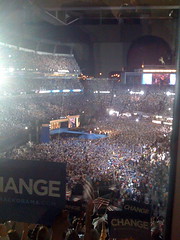
Argus Event Staffing successfully provided access control, credential verification, physical security, and customer service for the 2008 Democratic National Convention at the Pepsi Center and at INVESCO Field at Mile High. Additionally, Argus provided services for affiliated at events at Red Rocks Amphitheatre, the Denver Coliseum, the Colorado Convention Center, the Denver Performing Arts Complex, and for other private parties and venues throughout the Denver metropolitan area. We worked directly with the United States Secret Service, the Democratic National Convention Committee security and operations departments, and numerous local, state, and federal law enforcement agencies to coordinate efforts and produce the results that all of you may have seen on television.
Due to the sensitivity of the security surrounding the event, I did not post any information or pictures leading up to or during the event, but now that the event has come to a close, I wanted to at least share some pictures. Please note that I will not respond to requests for any information that may reveal anything related to the security of the event. All of the pictures were taken on my iPhone.
Here's a shot of the podium inside Pepsi Center:
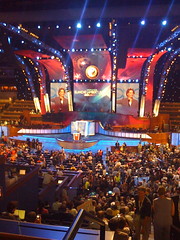
Here's a shot of INVESCO Field at Mile High before we opened doors:
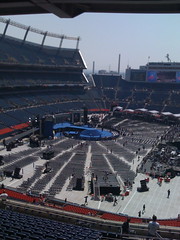
Here's one shot of Obama on stage with INVESCO Field at Mile High full:
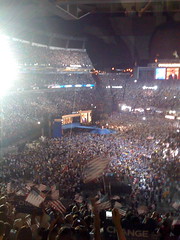
Here's another shot of Obama on stage at INVESCO Field at Mile High:
Tags: Democratic National Convention, DNC, security, Strategize, Ross Hollman
Sunday, August 31, 2008

Subscribe to:
Posts (Atom)